Summary:
Your fire extinguishers are hanging on the wall. They look fine. The pressure gauge shows green. But when was the last time someone actually inspected them? And do you have the documentation to prove it?
In Nassau County, that’s not just a good question—it’s the difference between passing a fire marshal inspection and facing fines that start at $300 per extinguisher. Business owners here don’t get a grace period. Annual professional inspections are mandatory, monthly visual checks are required, and if your tags are missing or outdated, you’re already in violation.
Here’s what you need to know about keeping your business compliant, your people safe, and your extinguishers actually ready to work when it matters.
What Fire Extinguisher Inspection Actually Means in Nassau County
Fire extinguisher inspection isn’t one thing. It’s a schedule of different checks happening at different intervals, and Nassau County enforces all of them.
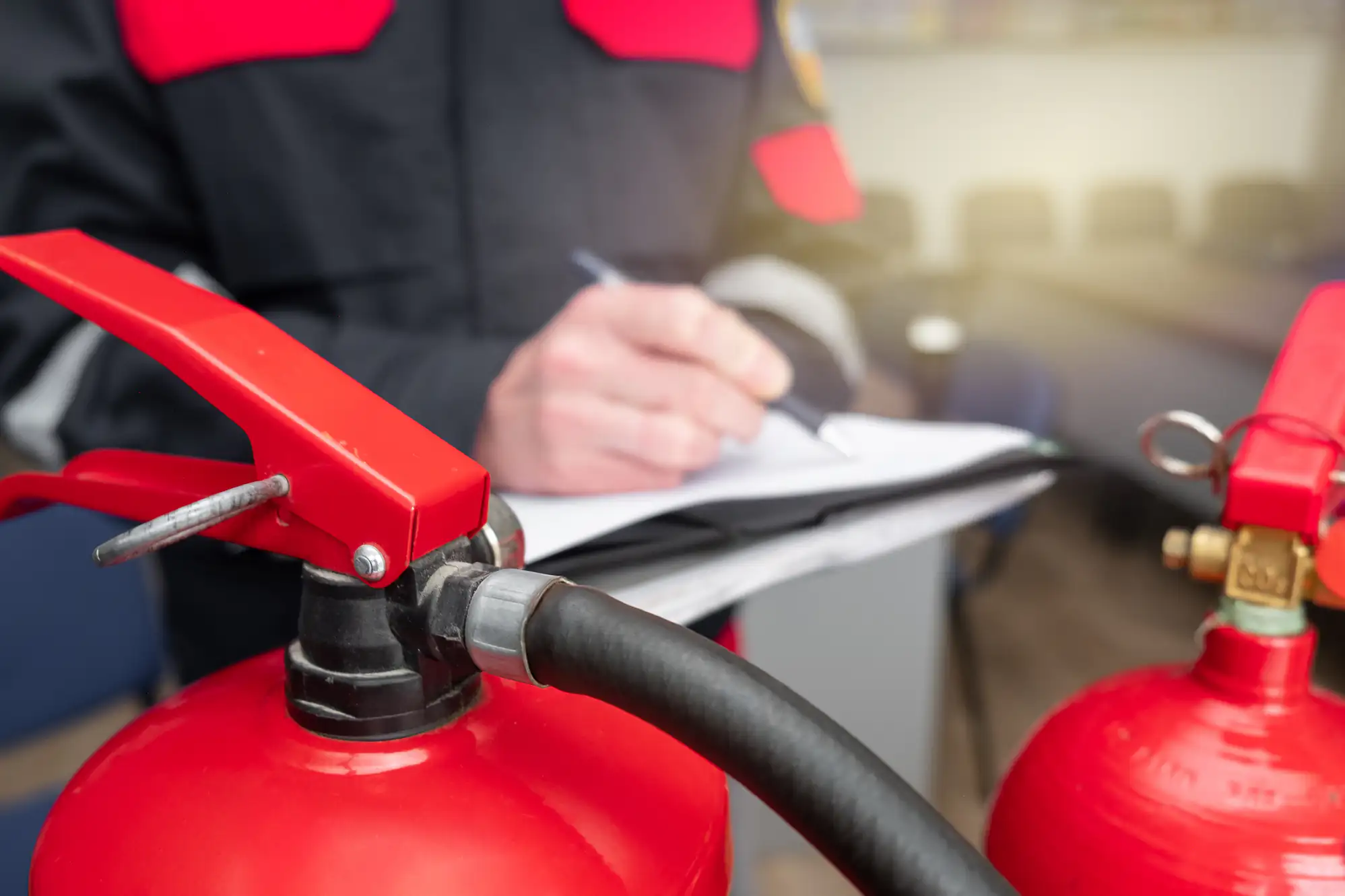
Monthly visual inspections can be done by your own staff. You’re checking that the extinguisher is in its designated spot, the pressure gauge is in the green zone, the pin and seal are intact, and there’s no visible damage. Takes a few minutes. Needs to be documented.
Annual professional inspections are different. These must be performed by a licensed, certified technician who examines the hose, valve, shell, discharge mechanism, and internal components. They verify the extinguisher will actually work if you need it. They attach a new inspection tag with the date and certification number. This isn’t optional, and you can’t do it yourself.
Then there’s 6-year maintenance, where stored pressure extinguishers get discharged, internally examined, refilled, and pressure-tested. And 12-year hydrostatic testing to verify the cylinder can still handle the pressure safely. Miss any of these, and you’re out of compliance before you even realize it.
NFPA 10 Fire Extinguisher Inspection Requirements
NFPA 10 is the standard that governs portable fire extinguishers across the United States, and Nassau County enforces it strictly. Understanding what it requires helps you know what to expect when a professional shows up for your annual inspection.
The standard breaks down inspections into clear categories. Visual inspections happen monthly at minimum—more often if your extinguishers are in high-risk areas or frequently obstructed. During these checks, you’re verifying the extinguisher is accessible, fully charged, and hasn’t been tampered with. A broken seal, even if the gauge looks fine, means someone may have partially used it. That requires immediate professional service.
Annual maintenance goes deeper. A certified technician removes the extinguisher from its bracket, checks the manufacture date and last service date, inspects the pressure gauge for accuracy, examines the valve and hose for cracks or blockages, and ensures labels and instructions are legible. They also verify the extinguisher type matches the fire hazards in that location. An ABC dry chemical extinguisher works for most fires, but a commercial kitchen needs a K-Class unit for grease fires. Putting the wrong type in the wrong place is a violation.
The 6-year requirement is where many businesses get caught off guard. Stored pressure extinguishers—the most common type—must be discharged, opened, and internally examined every six years from the date of manufacture. The technician replaces the valve stem and O-rings, refills the extinguisher with fresh agent, and pressure-tests it to confirm there are no leaks. This service typically costs $50-$85 per unit, but it’s required by code. Skipping it because “the extinguisher looks fine” doesn’t hold up during an inspection.
Hydrostatic testing happens at 12-year intervals for most extinguishers. The cylinder is emptied, pressurized with water to test its structural integrity, and inspected for weaknesses. If it passes, it’s refilled and returned to service. If it fails, it must be replaced. Some older extinguishers manufactured before 1984 must be removed from service entirely at the next test interval due to safety concerns identified in updated UL standards.
Documentation matters as much as the work itself. NFPA 10 requires that every inspection, maintenance event, and test be recorded with the date, technician name, and findings. These records must be kept for at least one year or the life of the extinguisher shell, whichever is less. When the fire marshal or insurance inspector asks to see your records, “I think we had someone look at them last year” isn’t going to cut it.
Commercial Fire Extinguisher Inspection vs. Monthly Checks
There’s a big difference between what you can do in-house and what requires a licensed professional. Understanding this distinction keeps you compliant and helps you avoid paying for services you could handle yourself.
Monthly visual inspections are designed for building staff to perform. You don’t need special training or equipment. You’re checking that each extinguisher is in its assigned location, mounted at the correct height, accessible without obstructions, and showing a pressure gauge reading in the operable range. You verify the pull pin and tamper seal are intact, the hose and nozzle are clear, and the instruction label is readable. This takes about two minutes per extinguisher if you know what you’re looking for.
The catch is documentation. NFPA 10 requires you to record these monthly checks, and Nassau County fire marshals will ask to see your logs during inspections. A simple checklist works—date, initials of the person who checked, and any issues found. If an extinguisher fails the visual check, it needs professional service immediately. Don’t wait until the annual inspection.
Commercial fire extinguisher inspection is the annual professional service. This must be performed by a technician certified by the fire marshal’s office and licensed to work in Nassau County. Not every fire protection company holds the right licenses. Companies licensed only for NYC cannot legally service Nassau County businesses, and vice versa. Using an unlicensed contractor means your inspection doesn’t count, your tags are worthless, and you’re still in violation even though you paid someone.
During the annual inspection, the technician performs a thorough examination that goes beyond what’s visible. They remove the extinguisher from its bracket to check the bottom for corrosion. They verify the manufacture date and last hydrostatic test date. They inspect internal components where applicable. They test the discharge mechanism. They check that the extinguisher weight matches the manufacturer’s specifications—because if it’s too light, it may have leaked agent over time even if the pressure gauge still shows green.
After the inspection, the technician attaches a new inspection tag showing the service date, their certification number, and the next due date. In Nassau County and NYC, these tags now include anti-fraud features like QR codes and holograms. Only approved companies can purchase them. If your extinguisher has a handwritten tag or one that looks generic, you’ve been scammed by an unlicensed contractor.
Professional inspection also includes identifying when extinguishers need recharging, 6-year maintenance, or replacement. A good technician doesn’t just tag what’s there—they tell you what’s coming due in the next six months so you can budget for it. They also verify you have the right number and type of extinguishers for your space. Nassau County fire code requires no point in a building to exceed 75 feet from the nearest Class A extinguisher. A 10,000-square-foot facility typically needs 15 to 20 units depending on layout and fire hazards.
The cost difference matters. Monthly checks cost you staff time—maybe 30 minutes total per month if you have a dozen extinguishers. Annual professional inspections run anywhere from $15-$35 per extinguisher depending on your location and the service provider. Some companies charge minimum service fees or trip charges, so it’s worth getting quotes from licensed contractors. Just make sure they’re actually licensed for Nassau County before you sign anything.
Fire Extinguisher Maintenance Service: What's Included and When You Need It
Maintenance goes beyond inspection. It’s the hands-on service that keeps extinguishers functional when monthly checks reveal problems or when scheduled intervals require internal work.
Fire extinguisher maintenance service includes recharging units that have been used or lost pressure, replacing damaged components like hoses or gauges, performing the required 6-year internal examination, and conducting hydrostatic testing at 12-year intervals. It also covers swapping out extinguishers that fail inspection with temporary replacements so your business stays protected while repairs happen.
A licensed fire extinguisher maintenance contractor handles all of this. They have the equipment to discharge and refill extinguishers safely, the training to identify internal corrosion or valve problems, and the certification to attach compliant inspection tags. They also maintain service records that prove your business is meeting NFPA 10 requirements.
Choosing the right contractor matters more than most business owners realize. Nassau County requires separate licensing, so verify your contractor holds the proper certificates before they touch your equipment. Ask how they handle documentation, what their response time is for emergency service, and whether they offer reminder scheduling for upcoming maintenance. The cheapest option often turns into the most expensive when you discover their tags aren’t legitimate.
Fire Extinguisher 6 Year Maintenance Cost and What It Covers
The 6-year maintenance requirement catches a lot of business owners off guard. You’ve been doing annual inspections, everything looks fine, and then suddenly you’re told half your extinguishers need a service that costs $50-$85 each. What’s actually happening?
NFPA 10 requires all stored pressure fire extinguishers to undergo internal examination every six years from the date of manufacture. This isn’t based on when you bought them or when they were installed—it’s based on the stamp on the cylinder showing when the manufacturer made them. If you bought extinguishers that had been sitting in a warehouse for two years, your 6-year clock started before you even owned them.
During 6-year maintenance, the technician discharges the extinguisher completely and removes the valve assembly. They inspect the inside of the cylinder for corrosion, moisture, or contamination. They replace the valve stem and all O-rings to prevent future leaks. They refill the extinguisher with fresh agent to the manufacturer’s specified weight. They pressure-test it with a soap and water solution to check for leaks. Then they attach both an annual inspection tag and a 6-year compliance sticker showing the work was completed.
Fire extinguisher 6 year maintenance cost varies by extinguisher type and size. Standard ABC dry chemical units typically run $50-$75 for the service. CO2 extinguisher maintenance costs slightly more because the agent is more expensive. Clean agent fire extinguisher systems and specialized units like Halotron can hit $85-$120 per unit. If you have 20 extinguishers and half of them hit their 6-year mark in the same year, you’re looking at $500-$750 in maintenance costs.
You can’t skip this. It’s not optional maintenance you can defer because business is slow. The 6-year requirement is written into NFPA 10, enforced by Nassau County fire codes, and checked during fire marshal inspections. If your extinguishers are past their 6-year date without the service, they’re considered non-compliant even if they passed the last annual inspection.
The good news is that a licensed contractor can often handle 6-year maintenance on-site if they have a mobile service vehicle. They bring the equipment to discharge, inspect, and refill extinguishers at your location. For businesses with many units, this saves time compared to removing extinguishers and bringing them to a shop. Just make sure the contractor provides temporary extinguishers to maintain fire protection while yours are being serviced.
Planning ahead helps with the cost. If you know when your extinguishers were manufactured, you can budget for 6-year maintenance before it becomes urgent. A good fire extinguisher service company tracks this for you and sends reminders 60-90 days before units come due. That gives you time to schedule the work and spread out costs if multiple extinguishers need service in the same year.
Some businesses try to avoid the expense by replacing extinguishers instead of servicing them. That rarely makes financial sense. A new 10-pound ABC extinguisher costs $60-$120 depending on brand and features. The 6-year maintenance runs $50-$75. You’re not saving much, and you’re throwing away an extinguisher that still has six more years of life after service. The only time replacement makes sense is if the cylinder shows corrosion during internal inspection or fails hydrostatic testing.
Portable Fire Extinguisher Maintenance for Different Extinguisher Types
Not all fire extinguishers are the same, and the maintenance requirements vary depending on what type you have. Using the wrong service procedure or skipping type-specific maintenance creates safety risks and compliance problems.
ABC dry chemical extinguishers are the most common in commercial buildings. They handle ordinary combustibles, flammable liquids, and electrical fires. Maintenance includes monthly pressure checks, annual professional inspection, 6-year internal examination with agent replacement, and 12-year hydrostatic testing. The dry chemical agent can cake or settle over time, so technicians check for clumping during the 6-year service.
CO2 fire extinguisher maintenance follows a different schedule. These units don’t have pressure gauges because they’re self-expelling. Instead, technicians verify proper weight during inspections—if the cylinder is too light, it’s leaked CO2 and needs recharging. Hydrostatic testing happens every five years for CO2 extinguishers, not twelve. The high-pressure cylinders require specialized testing equipment, so not all contractors can service them properly.
Clean agent fire extinguishers use gases like Halotron or FM-200 that leave no residue, making them ideal for server rooms, labs, or anywhere water or powder would cause damage. These systems require careful handling during maintenance because the agents are expensive and environmentally controlled. Technicians must capture and recycle the agent during service rather than venting it. Annual inspections verify the cylinder weight and pressure. Hydrostatic testing intervals vary by agent type—Halotron units test every 12 years, while some other clean agents test at different intervals.
K-Class extinguishers are required in commercial kitchens for grease fires. They use wet chemical agents specifically designed for cooking oil fires. The agent can separate or degrade over time, so the 6-year maintenance includes not just internal inspection but verification that the wet chemical is still effective. These units also have different discharge mechanisms that require specific training to service properly.
Water mist fire extinguishers are newer technology that uses deionized water in a fine mist. They’re effective on Class A fires and some electrical fires because the mist doesn’t conduct electricity like a stream would. Maintenance is similar to other stored pressure units, but the water must be deionized—regular tap water causes corrosion inside the cylinder. During 6-year service, technicians flush the system and refill with fresh deionized water.
Industrial fire extinguishers include wheeled units, specialized Class D extinguishers for metal fires, and large-capacity systems. These often have unique maintenance requirements spelled out by the manufacturer. A 150-pound wheeled ABC unit requires annual inspection just like a portable unit, but the 6-year maintenance is more complex because of the size and specialized components. Class D extinguishers use dry powder agents designed for specific metals, and the agent can’t be mixed or substituted.
The key is working with a fire extinguisher maintenance company that understands these differences and has the equipment and training to service all types properly. A contractor who only knows how to handle ABC units will either refuse to service your CO2 or clean agent systems, or worse, service them incorrectly and create a hazard. When you’re getting quotes for maintenance, ask specifically about the types of extinguishers you have and verify the contractor is equipped to handle them.
Keeping Your Nassau County Business Compliant and Protected
Fire extinguisher inspection requirements in Nassau County aren’t complicated once you understand the schedule: monthly visual checks by your staff, annual professional inspections by a licensed contractor, 6-year internal maintenance, and 12-year hydrostatic testing. What makes it challenging is tracking different timelines for multiple extinguishers and making sure your contractor is actually licensed for Nassau County.
The cost of compliance is predictable and manageable. The cost of violations isn’t. Fines start at $300 per extinguisher and can reach $1,000 for repeat offenses. Insurance companies can drop coverage or raise premiums. Fire marshals can order businesses closed until violations are corrected. And if an extinguisher fails during an actual fire because it wasn’t properly maintained, the liability goes beyond fines.
Working with a certified, experienced fire protection company makes the whole process simpler. We track your inspection schedules, send reminders before deadlines, provide proper documentation, and handle everything from routine inspections to emergency violation corrections. At Island Fire & Defense Systems, we serve Nassau County, Suffolk County, and NYC with NICET certified professionals who understand the specific requirements in each jurisdiction.