Summary:
You probably didn’t give much thought to your halon fire extinguisher until someone mentioned it’s been obsolete for 30 years. Now you’re facing questions about replacement options, environmental regulations, and whether your current system will even work if it ever needs to discharge.
The reality is straightforward. Halon production stopped in 1994 because these systems deplete the ozone layer. You can still use existing equipment and refill with recycled halon, but that supply is dwindling and reserved for critical applications like aviation. For most businesses in Nassau County, the practical path forward involves transitioning to modern clean agent systems that deliver the same level of protection without the environmental concerns.
This isn’t about creating urgency where none exists. It’s about understanding what halon phase-out actually means for your facility, what alternatives work for different applications, and what’s involved in making the switch. Let’s start with why halon became a problem in the first place.
Halon Fire Extinguisher Phase-Out and Replacement Options
Halon fire extinguishers were incredibly effective at one thing: stopping fires fast without damaging sensitive equipment. They worked by chemically interrupting combustion, left no residue, and could protect electronics, data centers, and valuable materials that water or foam would destroy. For decades, if you had a server room or telecommunications equipment in Nassau County, halon was the obvious choice.
Then researchers discovered the environmental cost. Halon contains bromine, which breaks down ozone molecules in the upper atmosphere. The ozone layer protects us from harmful UV radiation, and halon turned out to be one of the most destructive ozone-depleting substances ever used commercially.
The Montreal Protocol, an international environmental agreement signed in 1987, targeted halon for elimination. Production and import of new halon stopped in the United States on January 1, 1994. That doesn’t mean your existing system is illegal or that you’re required to rip it out tomorrow. What it does mean is that you’re operating on borrowed time with a technology that has no future supply chain beyond whatever recycled halon remains in circulation.
Can You Still Refill a Halon Fire Extinguisher?
Here’s where theory meets reality. Your halon system sits quietly for years, maybe decades, doing nothing. Then one day it discharges during a fire, or you discover during an inspection that pressure has dropped and it needs recharging.
Now you need halon. But remember, no new halon has been manufactured since 1994. The only source is recycled material recovered from decommissioned systems.
Commercial recyclers buy halon from old equipment, reclaim it to industry specifications, and sell it into continuing uses. The problem is that demand from critical applications like aviation, military operations, and oil and gas exploration competes for this shrinking supply. You can legally purchase recycled halon to refill your system. Nothing prohibits that. But availability is uncertain, costs are rising, and at some point, the math stops making sense.
You’re investing in maintaining a system built around a substance that becomes harder to source every year. The EPA regulations that govern halon also prohibit venting or releasing it during testing, maintenance, or disposal. If you’re decommissioning a halon system, you can’t just let it escape into the atmosphere. You need professionals who understand proper recovery procedures and can handle the material according to federal requirements.
This isn’t something you hand to the lowest bidder. Beyond the practical supply issues, there’s the environmental consideration. Even though using existing halon systems remains legal, many organizations are moving away from them as part of broader sustainability commitments. If environmental responsibility factors into your business decisions, continuing to rely on one of the most potent ozone-depleting substances available sends a particular message.
The transition question isn’t really “if” anymore for most Nassau County facilities. It’s “when” and “to what.” The good news is that the fire protection industry has spent 30 years developing alternatives that match or exceed halon’s performance without the environmental impact.
Which Clean Agent Fire Extinguisher Replaces Halon?
When fire protection engineers talk about “clean agents,” they mean fire suppression substances that leave no residue and won’t damage sensitive equipment. They’re the natural successors to halon for applications where water-based systems would cause more harm than the fire itself.
The main categories are halocarbon agents (synthetic chemicals) and inert gas systems (naturally occurring gases). Each works differently and suits different situations.
FM-200, chemically known as HFC-227ea, was one of the earliest halon replacements and remains widely used. It extinguishes fires by absorbing heat and disrupting the chemical reaction of combustion. FM-200 systems discharge in 10 seconds or less, are safe in occupied spaces, and require relatively little storage space compared to some alternatives.
The downside is environmental. FM-200 has a global warming potential of 3,220, meaning it contributes significantly to climate change. While it doesn’t deplete ozone, regulatory pressure is building. The EPA is phasing down HFC-based agents, and some regions are moving faster than others.
Novec 1230 fluid represents the next generation. It’s a fluoroketone that works similarly to FM-200 by removing heat, but with dramatically better environmental credentials. Novec 1230 has a global warming potential of 1—essentially the same as carbon dioxide—and an atmospheric lifetime of about five days compared to FM-200’s 33-36 years. It offers the highest safety margin for human occupancy among clean agents.
The catch is that 3M, the manufacturer, discontinued production of the chemicals needed for Novec 1230 in 2025 as part of their exit from PFAS chemicals. Existing systems can still be recharged with compatible alternatives like Fike SF 1230 or Kidde Fluoro-K, which are chemically identical.
Inert gas systems like Inergen take a completely different approach. Instead of chemical suppression, they work by reducing oxygen levels in the protected space below what’s needed for combustion while keeping it safe for humans to breathe. Inergen is a blend of nitrogen, argon, and carbon dioxide. It’s completely environmentally friendly with zero ozone depletion and minimal global warming impact. The tradeoff is space: inert gas systems require significantly more storage cylinders than halocarbon agents to protect the same area.
CO2 systems deserve special mention because they’re effective and leave no residue, but they’re not suitable for occupied spaces. Carbon dioxide suppresses fire by displacing oxygen, which means it creates an asphyxiation hazard for anyone in the room. CO2 works well for unoccupied areas or spaces where people can evacuate before discharge. It’s commonly used in electrical rooms, engine compartments, and industrial applications.
The question isn’t which agent is “best” in absolute terms. It’s which one makes sense for your specific application. Room size, occupancy, environmental priorities, budget, and available space for storage cylinders all factor into the decision. A data center with 24/7 staff presence has different needs than an electrical substation or archive storage area.
Clean Agent Fire Extinguisher Technologies
Switching from “halon fire extinguisher” to “clean agent fire extinguisher” isn’t just a vocabulary change. It represents a fundamental shift in how we think about fire protection for sensitive environments in Nassau County and beyond.
Clean agent systems are engineered solutions, not just equipment swaps. When you replace a halon system, you’re not simply pulling out old cylinders and dropping in new ones. The entire suppression system needs to be designed around the specific agent you’re using.
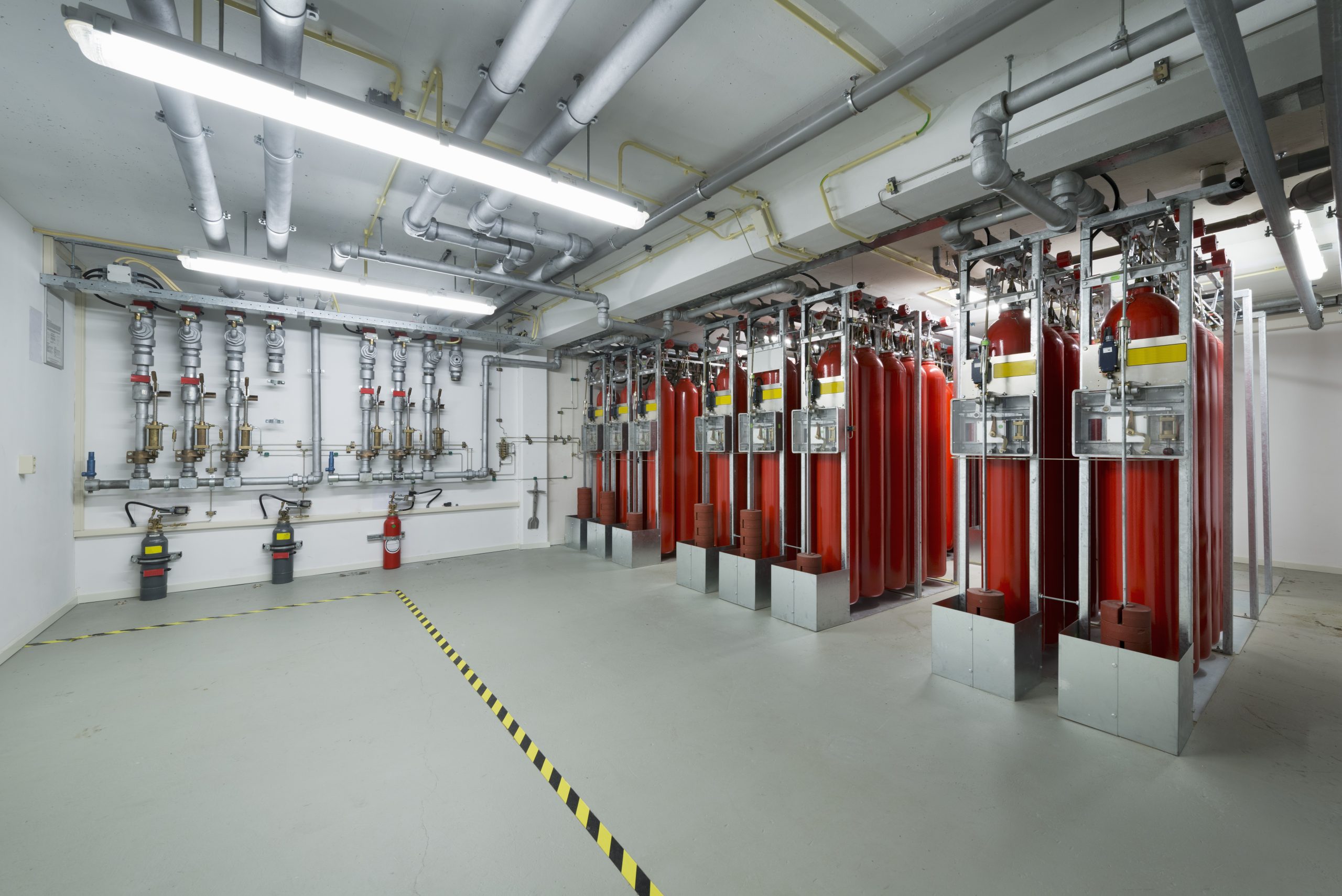
Factors like discharge time, agent concentration, room volume, and distribution piping all matter. Different clean agents have different physical properties. FM-200 is stored as a liquefied compressed gas and must discharge within 10 seconds, which often means cylinders need to be located close to the protected space. Novec 1230 is stored as a liquid but discharges as a gas, with similar space requirements. Inert gases are stored and discharged as gas, requiring more cylinders but allowing greater distance between storage and the protected area due to higher pressure.
Why Professional Installation Matters for Fire Suppression Systems
Fire suppression systems for sensitive environments aren’t DIY territory. The consequences of getting it wrong range from system failure when you need it most to creating life safety hazards.
Licensed fire protection professionals bring specific expertise that matters. Conducting risk assessments, performing precise calculations for agent quantities, designing discharge piping for proper distribution, selecting appropriate detection systems, and ensuring compliance with NFPA standards and local fire codes all require specialized knowledge.
In New York, that means understanding state and local licensing requirements, FDNY regulations for NYC properties, and Nassau County fire marshal expectations. NICET certification (National Institute for Certification in Engineering Technologies) indicates that technicians have demonstrated knowledge and competency in fire protection systems. It’s not just a credential for the sake of credentials. It means someone has proven they understand the technical requirements and can apply them correctly.
The installation phase is where design becomes reality. Proper mounting of cylinders, correct pipe sizing and routing, leak-free connections, appropriate nozzle placement, integration with building fire alarm systems, and thorough testing before the system goes live all require trained professionals with the right tools and experience.
Maintenance doesn’t end once the system is installed. Clean agent systems need regular inspection to verify cylinder pressure, check for physical damage or corrosion, ensure detection devices function properly, test control panels and release mechanisms, and maintain accurate documentation of all service.
Different agents have different testing intervals. CO2 systems, for example, require hydrostatic testing every five years to ensure cylinder integrity. This is specialized work. A company that only services portable fire extinguishers may not have the expertise for total flooding clean agent systems.
You want a fire protection contractor with specific experience in the type of system you’re installing, familiarity with the agent you’ve selected, and a track record with installations similar to yours. For businesses in Nassau County and the surrounding area, working with a locally established contractor offers advantages. They understand regional fire codes, have relationships with local fire marshals and inspectors, can respond quickly for service or emergencies, and know the specific challenges of protecting facilities in this market.
CO2 Fire Extinguisher Maintenance and Safety Requirements
CO2 fire extinguishers and suppression systems occupy a specific niche in fire protection. They’re highly effective for Class B (flammable liquids) and Class C (electrical) fires, leave no residue, and have been used for decades in applications where water or chemical agents would cause damage.
But CO2 systems require specialized maintenance knowledge because they operate under high pressure and present unique safety considerations.
Carbon dioxide extinguishers don’t have pressure gauges like dry chemical units. Instead, they’re weighed during inspection to verify they’re fully charged. This requires properly calibrated scales and technicians who know the correct weight specifications for each extinguisher model. If an extinguisher is even slightly underweight, it needs recharging.
The maintenance intervals are specific. CO2 fire extinguishers require annual inspection like other types, but they have a 12-year maintenance interval that involves thorough inspection of the shell, hoses, discharge horns, and valves. Hydrostatic testing happens every five years for portable CO2 extinguishers to ensure the pressure vessel’s integrity.
This test involves pressurizing the cylinder to a specific level to check for leaks or weaknesses. The high-pressure nature of CO2 systems means safety protocols matter during maintenance. Discharge horns get extremely cold when CO2 releases—it converts from liquid to gas, creating a “snow” effect. Technicians need to understand proper handling to avoid frostbite injuries.
In confined spaces, CO2 creates an asphyxiation hazard because it displaces oxygen. Service work on larger CO2 systems requires understanding ventilation requirements and occupant safety procedures. For total flooding CO2 suppression systems (as opposed to portable extinguishers), the complexity increases significantly. These systems protect entire rooms or enclosures by releasing enough CO2 to displace oxygen below combustion levels. They’re common in electrical rooms, engine compartments, and industrial processes.
Maintenance involves checking all storage cylinders, inspecting distribution piping, testing detection and release mechanisms, verifying pre-discharge alarms, and ensuring the protected space maintains proper integrity to hold the agent. Documentation requirements for CO2 systems are stringent because of the life safety implications. Every inspection, test, and maintenance action needs recording. Hydrostatic test dates must be tracked. Cylinder weights need logging. Service tags must be current and legible.
The technical knowledge required for CO2 fire extinguisher maintenance is why this work needs certified professionals. Understanding pressure vessel regulations, knowing proper testing procedures, having the right equipment for hydrostatic testing and recharging, and managing the safety protocols around high-pressure CO2 all require specific training and experience. This is particularly important for facilities in Nassau County where fire code compliance and proper documentation can make the difference during inspections.
Transitioning from Halon to Modern Fire Protection Systems
If you’re still operating a halon fire extinguisher or suppression system in Nassau County, you’re not alone. Plenty of facilities have legacy equipment that continues to function. But the question you’re facing is less about whether to transition and more about when and how.
The halon phase-out happened 30 years ago, but the practical implications are hitting now as recycled supplies tighten and businesses prioritize environmental responsibility. Modern clean agent alternatives deliver the same level of protection for sensitive equipment without the ozone depletion issues.
FM-200, Novec 1230, Inergen, and CO2 systems all have appropriate applications depending on your specific needs. The transition process requires professional expertise. Proper halon decommissioning and recovery, accurate system design for the replacement agent, installation that meets NFPA and local fire code requirements, and ongoing maintenance to keep everything functioning correctly all demand certified professionals who do this work regularly.
At Island Fire & Defense Systems, we specialize in fire protection system transitions for businesses throughout Nassau County, Suffolk County, and NYC. With NICET-certified professionals, proper New York State and local licensing, and experience with complex system installations, we can guide you through the process from initial assessment to final commissioning and beyond.