Summary:
You scheduled the annual inspection. The technician came out, checked the units, updated the tags. From where you’re standing, you’re covered.
Here’s the problem: the annual inspection is one of four mandatory service intervals under NFPA 10. Most facility managers only know about one of them. The other three — including a 6-year internal examination that opens the extinguisher and checks what the annual inspection never touches — are where compliance quietly breaks down across Nassau County properties.
This page walks through every required interval, what each one actually involves, and what Nassau County specifically requires of the businesses and properties within its jurisdiction.
Annual Fire Extinguisher Inspection Requirements
Under NFPA 10, the annual maintenance inspection is the one most businesses are familiar with — and for good reason. It’s required every 12 months without exception, it must be performed by a trained and certified technician, and it produces the dated service tag that fire marshals and insurance carriers look for first.
But “annual inspection” doesn’t mean the same thing to every provider. A thorough annual maintenance examination covers the mechanical components, the extinguishing agent, the expelling mechanism, and the overall condition of the unit. The technician recharges the unit if pressure has dropped, replaces any compromised components, and documents the service with a tag and a written record.
What it does not include is opening the extinguisher — that’s a separate requirement entirely, and it only comes due every six years.
What the Annual Inspection Actually Checks — and What It Misses
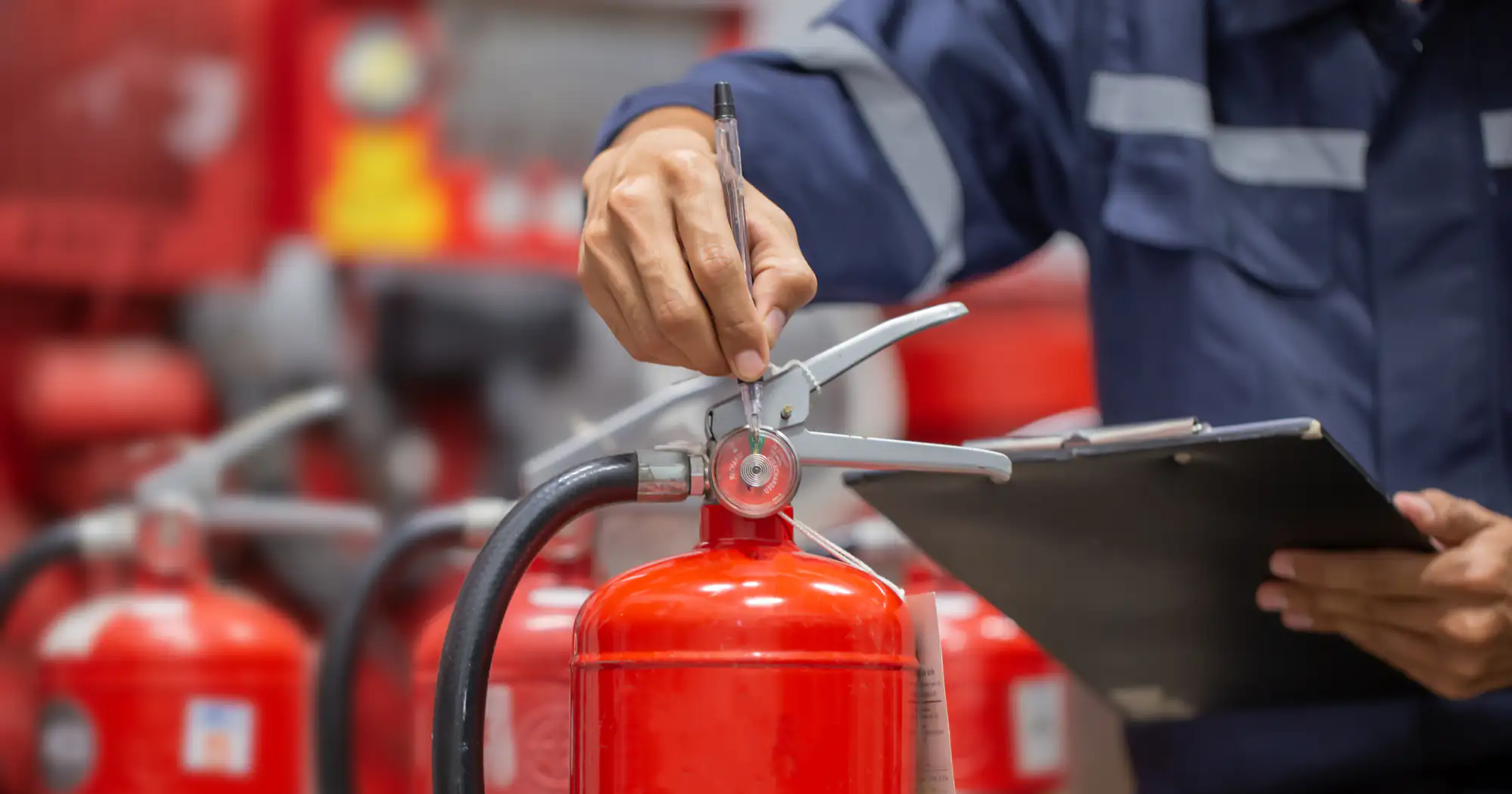
During an annual inspection, a certified technician examines the extinguisher from the outside in. They verify the pressure gauge reads within the operable range, confirm the locking pin and tamper seal are intact, check for physical damage or corrosion on the exterior, make sure the nozzle isn’t blocked, and confirm the operating instructions are still legible. If the unit needs to be recharged, that happens at this visit.
What the annual inspection does not do is tell you anything about the condition of the internal components. Corrosion can develop on the inside of a cylinder that looks perfectly fine on the outside. The dry chemical agent can pack or cake over time, reducing its effectiveness. The valve assembly can degrade internally without any visible sign.
None of that shows up during an annual inspection — and none of it will show up on the tag. This is exactly why approximately 15% of fire extinguishers are found to be undercharged or otherwise deficient during professional inspection. The gauge reads green. The tag is current. But the unit won’t perform the way it needs to when it actually matters.
That’s the gap the 6-year internal examination is designed to catch — and it’s the interval that most facilities in Nassau County are quietly missing.
One more thing worth noting on documentation: the annual inspection record needs to be more than a tag. A compliant service record captures the date, the technician’s name and credentials, the location and identification number of each unit, and the outcome of the inspection. Any deficiency found should be noted along with the corrective action taken and the date it was resolved.
If a fire marshal or insurance carrier asks to see your records and you can’t produce them, an undocumented inspection is treated the same as no inspection at all.
Monthly Visual Inspections: Who Does Them and What They Cover
NFPA 10 also requires a monthly visual inspection of every portable fire extinguisher on the premises. Unlike the annual maintenance inspection, this one doesn’t require a certified technician — it can be performed by a trained member of your own staff. But it still needs to happen every month, and it still needs to be documented.
The monthly inspection is a quick but deliberate check. The person performing it confirms the extinguisher is in its designated location and hasn’t been moved or blocked. They verify the pressure gauge is in the operable range. They check that the locking pin is in place, the tamper seal is unbroken, and there’s no visible damage, corrosion, or obstruction at the nozzle. They also confirm the operating instructions are facing outward and legible.
What trips up a lot of Nassau County property managers isn’t the inspection itself — it’s the log. A monthly walk-through that isn’t recorded doesn’t exist from a compliance standpoint. When the fire marshal asks for your monthly inspection records and you hand them a blank sheet, the result is the same as if you never looked at the units at all.
Nassau County fines for fire extinguisher violations can reach $1,000 per extinguisher. That adds up fast across a commercial property with a full inventory of units. Building a simple, consistent monthly log — date, inspector name, unit location, result — is the lowest-effort compliance step available to you, and it’s the one most facilities skip.
The monthly inspection is not a substitute for the annual maintenance examination, and neither of those replaces the 6-year or 12-year service requirements. Each interval catches different things. All four are mandatory.
Fire Extinguisher Inspection Schedule: All Four NFPA 10 Intervals
NFPA 10 establishes four distinct service intervals for portable fire extinguishers. Most facility managers know about one or two. Here’s the complete picture.
The monthly visual inspection is a quick check performed by trained building staff — no certification required, but documentation is mandatory. The annual maintenance inspection requires a certified technician, covers mechanical components and the extinguishing agent, and produces the service tag and written record. The 6-year internal examination requires the extinguisher to be depressurized and opened for a thorough internal inspection. And the 12-year hydrostatic test pressurizes the cylinder with water to verify structural integrity — if it fails, the unit is condemned and removed from service.
What Is the 6-Year Fire Extinguisher Inspection — and How Do You Know If You're Due?
The 6-year internal examination is the interval that catches Nassau County facilities off guard more than any other. It’s been in NFPA 10 for decades, but it rarely comes up during a standard annual service call unless your technician is specifically tracking it.
Here’s what the 6-year examination actually involves: the extinguisher is fully depressurized and disassembled. The technician inspects the interior of the cylinder for corrosion, pitting, or contamination. They examine the valve assembly, the siphon tube, and the condition of the dry chemical agent. If the agent has caked or packed — which happens more often than you’d expect — it won’t discharge properly in an emergency, even if the gauge reads full.
After the internal examination, the unit is reassembled, recharged, and returned to service with an updated tag reflecting the 6-year maintenance date.
The tricky part is timing. The 6-year interval is calculated from the manufacture date stamped on the cylinder — not from the date of the last annual inspection, and not from when the unit was first installed at your property. If your extinguishers were manufactured in 2018 or earlier and haven’t had a documented 6-year internal exam, there’s a real possibility they’re overdue right now.
It gets more complicated when you factor in that most commercial properties have extinguishers from multiple manufacturers, purchased or replaced at different times. That means the 6-year schedule isn’t a single date you can put on a calendar for the whole building — it’s a staggered series of individual deadlines, one per unit. Tracking that without a system is how facilities end up years behind without realizing it.
Class K extinguishers — the wet chemical units required in commercial kitchens — follow a different schedule entirely. They’re on a 5-year internal examination and hydrostatic test cycle, not 12 years. For Nassau County, NY restaurant operators along the Hempstead Turnpike corridor or anywhere else with commercial kitchen equipment, this is a compliance detail that most extinguisher-only providers won’t flag proactively.
The 12-Year Hydrostatic Test: What It Is and When Units Get Retired
At the 12-year mark from the manufacture date, every rechargeable fire extinguisher must undergo a hydrostatic test. This is a structural integrity test — the cylinder is filled with water and pressurized to a specified test pressure to determine whether the shell can safely contain the force of a full discharge. If the cylinder passes, it’s returned to service. If it fails, it’s condemned and cannot be repaired or recharged.
Hydrostatic testing is performed by a certified facility with the proper equipment — it’s not something that happens during a standard service call. The technician removes the unit, sends it for testing, and either returns it to service or replaces it depending on the outcome. Given that the average lifespan of a chemical fire extinguisher is approximately 10 years with regular maintenance, many units approaching their 12-year hydrostatic test are already candidates for replacement rather than recertification.
Non-rechargeable extinguishers — the disposable units common in smaller commercial spaces — follow a simpler rule: they must be removed from service at 12 years from the manufacture date, regardless of condition. There’s no hydrostatic test option for these units. If the date on the bottom of the cylinder is more than 12 years ago, the unit needs to come off the wall.
For Nassau County facility managers, the hydrostatic test interval is where deferred maintenance becomes genuinely dangerous. A unit that looks fine, holds pressure on the gauge, and carries a current annual inspection tag can still be structurally compromised if the cylinder hasn’t been tested. The annual inspection doesn’t catch that. Neither does the monthly visual check. Only the hydrostatic test does — and only if someone is tracking when it’s due.
This is where working with a provider who tracks each unit individually by manufacture date makes a real difference. We document the manufacture date, last annual inspection, last 6-year exam, and hydrostatic test status for every extinguisher on site. That way, nothing slips through.
Professional Fire Extinguisher Inspection Services in Nassau County, NY
If you manage a commercial property in Nassau County, NY, the compliance picture is more layered than a single annual inspection. NFPA 10 requires four service intervals, Nassau County’s Article XXIII adds a local regulatory layer on top of the national standard, and the fire marshal doesn’t distinguish between “I didn’t know” and “I skipped it.” The fine is the same either way — up to $1,000 per extinguisher.
What you need is a provider who holds the right credentials for this specific jurisdiction. That means Nassau County licensing, not just a state license. It means NICET-certified technicians who can identify what the annual inspection misses. And it means documentation that will hold up when the fire marshal asks to see it.
Island Fire & Defense Systems is Nassau County licensed (2019AEL75352 / PEL000000259), NICET certified, and approved by both the Nassau County Fire Marshal and FDNY. We track every unit individually, handle all four NFPA 10 service intervals, and produce the documentation your property needs to stay compliant. Reach out to us to schedule an inspection or find out where your extinguishers stand on the full compliance timeline.