Summary:
If you run a restaurant, deli, catering hall, or any commercial kitchen in Nassau County, you’ve probably got a fire suppression system installed above your cooking equipment. You may even have had it serviced recently. But here’s the question most operators can’t answer with confidence: does your system actually meet what NFPA 96 requires right now?
Not what it required when it was installed. Not what passed inspection three years ago. What it requires today — given your current equipment, your current cooking operation, and Nassau County’s current enforcement standards.
That gap between “we have a system” and “we’re actually compliant” is where most violations come from. This page is about closing it.
What Is Commercial Kitchen Fire Suppression and Why Does NFPA 96 Govern It?
NFPA 96 — formally titled the *Standard for Ventilation Control and Fire Protection of Commercial Cooking Operations* — is the national standard that governs how commercial kitchens manage fire risk. It covers everything from hood design and duct slope to suppression system installation, inspection frequency, and what has to happen automatically when a fire breaks out. When New York adopted the International Fire Code, it brought NFPA 96 along with it, making the standard enforceable law across the state — including Nassau County.
The standard exists because cooking equipment is the leading cause of fires in food service establishments. According to NFPA data from 2014 through 2018, cooking equipment accounted for over 60% of fires in eating and drinking establishments, resulting in more than $165 million in direct property damage every year. Grease fires in particular are fast, intense, and hard to stop once they start — especially with the vegetable-based cooking oils most kitchens use today, which reach their flash point faster than the animal fats they replaced.
A commercial kitchen fire suppression system is the last line of defense when everything else fails. NFPA 96 defines exactly what that system must do — and it’s more specific than most operators realize.
What Does NFPA 96 Actually Require Your System to Do?
This is where a lot of restaurant owners get surprised. Most people assume a fire suppression system just sprays agent onto a fire and puts it out. That’s part of it — but NFPA 96 Section 8.7 requires more than that.
When your suppression system activates, three things must happen simultaneously and automatically: the wet chemical agent must discharge onto the cooking surfaces and into the hood plenum; all fuel sources supplying heat to the protected cooking equipment must shut off; and electrical power to that equipment must cut out as well. All three. At the same time. Automatically. And the fuel and power cannot be restored until someone manually resets the system.
Why does this matter? Because if your gas line stays open while a fire is burning, the suppression agent can knock down the flames momentarily — and then the fire restarts the moment the agent dissipates. A system that suppresses without cutting the fuel is not just non-compliant. It’s genuinely dangerous in a way that may not be obvious until something goes wrong.
This fuel and power shut-off integration is one of the most commonly missed compliance requirements we encounter. It’s not always installed correctly on older systems, and it’s not always verified during routine service visits by contractors who aren’t looking carefully. If you’re not sure whether your system has proper automatic shut-off integration, that’s worth finding out before your next inspection — not during it.
NFPA 96 also requires that all new and replacement systems be UL 300 listed. This is the Underwriters Laboratories standard that commercial kitchen suppression systems must meet. Systems installed before 1994 typically used dry chemical agents and do not carry a UL 300 listing. Under NFPA 96 Section 10.1, those older systems must be replaced when your cooking operation changes — new appliances, different cooking oils, hood modifications. If you’ve updated your equipment since your suppression system was installed and no one has reviewed the system against the current standard, that’s a compliance gap that may not surface until an inspector flags it.
How Often Does a Commercial Kitchen Suppression System Need to Be Inspected?
NFPA 96 requires semiannual inspection and testing of commercial kitchen fire suppression systems — every six months, without exception. That’s not a suggestion and it’s not a baseline you can upgrade to annually if things look fine. Six months is the requirement, and Nassau County’s enforcement of this standard means a restaurant that’s only inspecting once a year is already out of compliance.
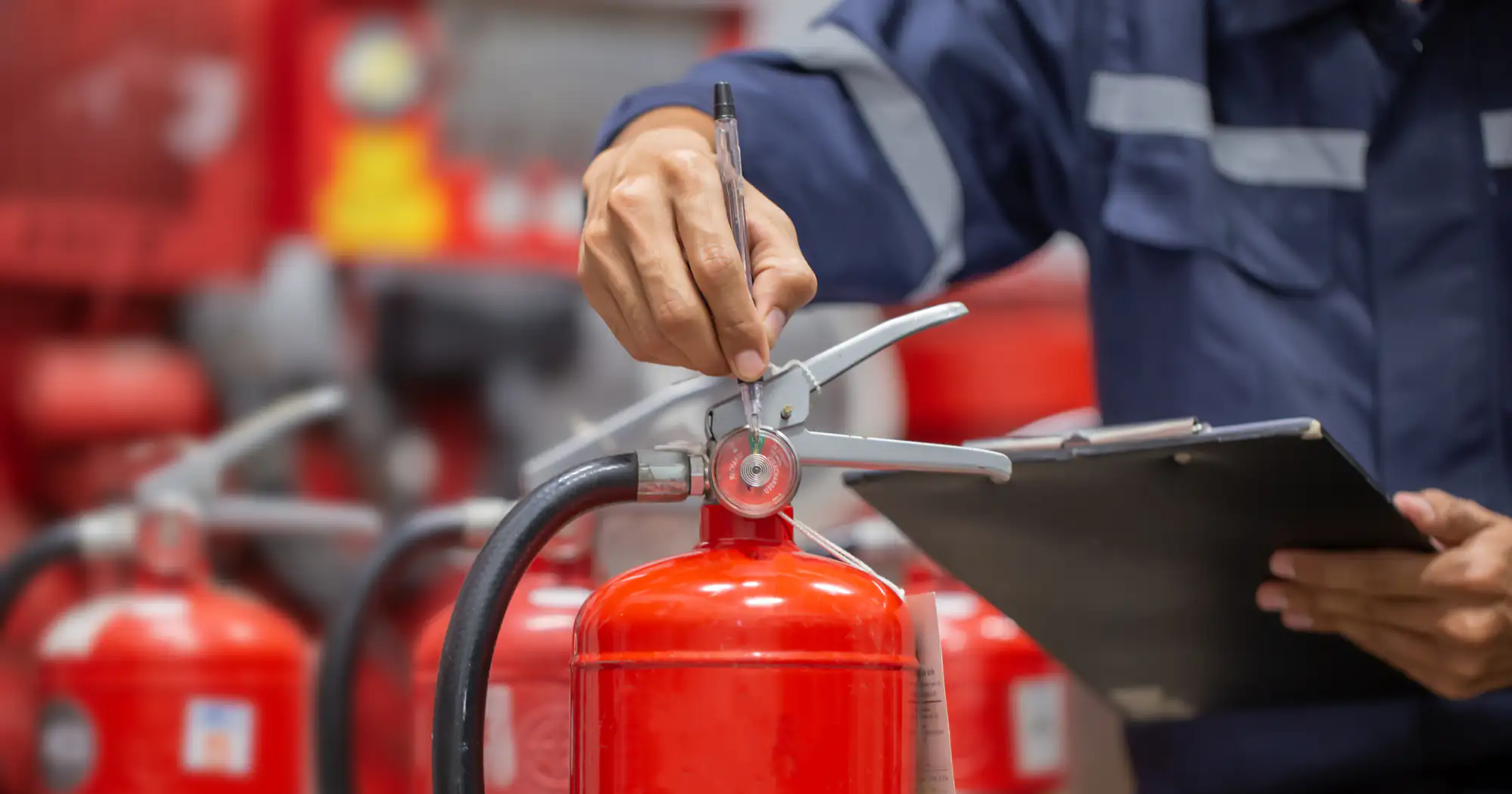
Each inspection needs to cover specific items: running diagnostics per NFPA standards, verifying nozzle aim and checking for blockages, confirming blow-off caps are in place, testing remote pulls and manual release stations, implementing automatic trip tests, and verifying that the Owner’s Manual is accessible on-site. Every visit should be documented — date, technician credentials, findings, and next scheduled service. If it’s not written down, it didn’t happen as far as an inspector is concerned.
Beyond the suppression system itself, Nassau County requires quarterly professional cleaning of commercial cooking exhaust systems — the hood, the duct, and the grease removal components. That’s more frequent than the national baseline. High-volume kitchens may need cleaning even more often. And if grease accumulation exceeds one-eighth of an inch at any point in the system, immediate cleaning is required regardless of when the last scheduled cleaning occurred.
This is one of the things that catches Nassau County operators off guard: the cleaning schedule is stricter here than in many other jurisdictions. A contractor who services restaurants in other markets may not flag that difference unless they know Nassau County’s requirements specifically. Working with a contractor who is licensed and active in Nassau County — not just broadly licensed in New York State — matters precisely because of details like this.
One more thing on inspections: if your system has been serviced but you don’t have the documentation to prove it, you’re in the same position as if it hadn’t been serviced at all. When the Nassau County Fire Marshal or a DOH inspector asks for your inspection records, the paperwork is the compliance. Keep it current, keep it accessible, and make sure your service provider is producing it as a standard part of every visit.
Restaurant Fire Suppression System Requirements Specific to Nassau County
Nassau County has its own enforcement structure layered on top of the New York State Uniform Fire Prevention and Building Code. The Nassau County Fire Commission Office of the Fire Marshal maintains a published list of contractors licensed to install and service kitchen fire-extinguishing systems in the county. Only contractors on that list are legally authorized to do this work here. It’s a meaningful distinction — and one that a lot of restaurant operators don’t know about until they’ve already hired someone who isn’t on it.
Island Fire & Defense Systems holds Nassau County license 2019AEL75352 / PEL000000259 and is approved by the Nassau County Fire Marshal. That’s verifiable directly on the county’s published contractor list. It’s not a marketing claim — it’s a matter of public record, and it’s the baseline standard for anyone doing suppression system work in Nassau County.
Fire Safety for Restaurants: What Nassau County Operators Get Wrong Most Often
Nassau County has over 5,700 permitted food service establishments — restaurants, delis, catering halls, school kitchens, mobile food trucks, and more. That’s a lot of kitchens, and a lot of suppression systems at various stages of compliance. After working across Nassau County communities like Hempstead, Freeport, Mineola, Hicksville, Great Neck, and Garden City, certain patterns come up again and again.
The first is the legacy system problem. A lot of Nassau County restaurants — particularly those in older strip-mall buildings and Main Street storefronts — are running suppression systems that were installed before 1994. These systems use dry chemical agents and do not meet the UL 300 standard that NFPA 96 now requires. They may have passed inspections for years. But under NFPA 96, a pre-UL 300 system must be replaced when the cooking operation changes. If you’ve added a fryer, switched to a different cooking oil, or modified your hood since that system went in, the clock may already be running on a required replacement — whether you know it or not.
The second is the nozzle aim issue. Suppression system nozzles must be aimed precisely at each protected cooking surface. When equipment gets moved, replaced, or added without a corresponding system review, nozzles that were once correctly aimed may no longer be covering the right targets. This is a common finding during inspections and it’s an easy thing to miss if the technician doing your semiannual service isn’t checking aim as part of their process.
The third is documentation. Nassau County DOH requires written clearance before a food service facility can reopen after a suppression discharge event. That clearance process goes faster — and creates fewer problems — when your inspection records are current, complete, and accessible. Operators who have been cutting corners on documentation find out why it matters at exactly the wrong moment.
What to Do If You Receive a Nassau County Fire Suppression Violation Notice
Getting a violation notice from the Nassau County Fire Marshal is stressful, but it’s not the end of the world. What matters most in that moment is moving quickly and working with a contractor who knows how Nassau County’s enforcement process works — because the path from violation to clearance involves specific documentation, specific corrections, and sign-off from the right authorities.
The first thing to understand is that a violation notice is not an accusation. It’s a finding that something in your system doesn’t meet the current standard. That could be a missing inspection record, a nozzle that’s out of position, a fuel shut-off that wasn’t integrated correctly, or a legacy system that needs to be replaced. Each of those has a different correction path, and the timeline for resolving it depends on what the violation actually is.
The second thing to understand is that not every fire protection contractor can legally resolve a Nassau County suppression system violation. The work has to be performed by a contractor holding the appropriate county license. If you bring in someone who isn’t on the Nassau County Fire Marshal’s approved list, the correction won’t be accepted — and you’ll be back to square one, with time and money spent and the violation still open.
We hold Nassau County license 2019AEL75352 and are approved by the Nassau County Fire Marshal. When a violation notice comes in, we can assess the system, identify what needs to be corrected, perform the work, and produce the documentation needed for clearance. Our technicians are NICET certified, which means the technical work meets the credentialing standard that inspectors and insurers recognize. We also handle the full scope in-house — suppression system, hood and duct, fire alarm integration, and fire alarm drawings — so there’s no coordination gap between multiple contractors when time matters.
If you’ve received a violation notice and you’re not sure what it means or what to do next, that’s exactly the kind of situation we can walk you through. The goal is to get you compliant and back to operating normally, with documentation that holds up the next time an inspector comes through.
Getting Your Commercial Kitchen Fire Suppression System Right in Nassau County
NFPA 96 compliance isn’t complicated once you understand what it actually requires — but there’s a real gap between having a suppression system and having one that meets the standard as it stands today. Semiannual inspections, UL 300 listed equipment, automatic fuel and power shut-off integration, correct nozzle placement, and complete documentation: all of it matters, and all of it gets checked.
Nassau County has its own enforcement structure, its own licensed contractor list, and its own cleaning requirements that go beyond the national baseline. Working with a contractor who knows that landscape — and is authorized to work within it — is the difference between a smooth inspection and a violation notice.
If you’re not sure where your system stands, or if you’ve already received a notice and need to move fast, Island Fire & Defense Systems is ready to help. Reach out for a free estimate and let’s take a look at what your system actually needs.