Summary:
If you manage or own a commercial property in Nassau County, you’ve probably already figured out that fire protection isn’t as simple as buying a smoke detector and calling it done. The county operates under its own Fire Prevention Ordinance, enforced by the Nassau County Fire Marshal, and it adds requirements on top of what New York State already mandates. When the two conflict, the stricter one applies — every time. That gap catches a lot of property owners off guard. This guide is here to close it. By the end, you’ll have a clearer picture of the system types available, how to match one to your building, and what Nassau County specifically expects from you.
Commercial Fire Alarm Panel Types: What They Are and Why It Matters
The fire alarm control panel — the FACP — is the brain of your entire fire protection system. Every detector, pull station, and notification device in your building connects back to it. When something triggers an alarm, the panel is what processes that signal, identifies the source, and initiates the appropriate response. Choosing the wrong panel type for your building doesn’t just create headaches — it creates compliance gaps that Nassau County inspectors will find.
There are four main panel configurations used in commercial buildings today: conventional, addressable, wireless, and hybrid. Each one has a different way of communicating information, and the right choice depends on your building’s size, layout, occupancy type, and what the Nassau County Fire Marshal requires for your specific use case.
Conventional vs. Addressable Fire Alarm Panels: Which Is Right for Your Building?
Conventional panels divide a building into zones. When a detector triggers, the panel tells you which zone is affected — but not which specific device. In a small, straightforward building, that’s usually enough information for occupants and responders to act quickly.
But in a larger commercial space with multiple floors, long corridors, or complex layouts, “Zone 3” doesn’t tell anyone much. Response time slows, and that matters when seconds count. In Nassau County’s densely developed commercial corridors — along Hempstead Turnpike, Northern Boulevard, and in retail centers across Hicksville and Westbury — most properties are large enough that zone-only information creates real response delays.
Addressable panels work differently. Every device connected to the system has a unique address, so when something triggers, the panel tells you exactly which detector, in which room, on which floor. For most commercial buildings in Nassau County — restaurants, medical offices, retail spaces — an addressable system isn’t just a nice upgrade. It’s the practical standard, and increasingly the code expectation.
Wireless panels eliminate the need for hardwired runs between devices, which makes them particularly useful in retrofit situations where running conduit through existing walls is disruptive or cost-prohibitive. They’re also common in historic buildings where structural integrity can’t be compromised. The tradeoff is that wireless systems require regular battery maintenance and signal monitoring to stay reliable. Hybrid panels combine hardwired and wireless components, giving you flexibility when a building has some areas that are easy to wire and others that aren’t.
For most new commercial installations in Nassau County, an addressable system is the baseline recommendation. The county’s enforcement posture is active — the Fire Marshal’s Office conducts regular inspections, and violations are common when systems don’t meet the specificity requirements the code demands. If your building is large enough to require a fire command center or has floors below grade, you’re also likely subject to BDA (Bi-Directional Amplifier) requirements, which means your panel needs to integrate with additional life safety infrastructure. That’s a layer many property owners don’t know about until they’re already in the permitting process.
What to Look for in a Commercial Fire Alarm Control Panel
Beyond the conventional-versus-addressable question, there are a few practical things worth understanding when evaluating a commercial fire alarm control panel for a Nassau County property.
First, the panel needs to be appropriate for your occupancy classification. A restaurant, a medical office, a warehouse, and a school all have different detection requirements based on ceiling height, airflow patterns, the number of occupants, and how quickly a fire could spread in that environment. A panel that’s correctly sized and configured for one occupancy type can be completely wrong for another — and that mismatch will show up during inspection.
Second, look at the manufacturer behind the equipment. Commercial-grade panels from established manufacturers like Notifier by Honeywell are designed for the demands of commercial and industrial applications. They’re not the same as the equipment you’d find at a home improvement store, and Nassau County inspectors know the difference. Using residential-grade equipment in a commercial setting isn’t just a code violation — it’s a liability exposure that follows you if something goes wrong.
Third, think about scalability. If your business is growing, or if you’re managing a building that may change tenants or occupancy classifications over time, you want a panel that can expand without a full replacement. Addressable systems generally handle this better than conventional ones, and some manufacturers offer modular configurations that make adding devices or zones straightforward.
Finally, documentation matters more than most people realize. Nassau County requires annual professional inspections with maintained records. Your panel should support the kind of detailed reporting that satisfies the Fire Marshal’s documentation requirements — not just a green light on the front of the box. We produce fire alarm engineering drawings in-house, which means the permitting process moves faster and the documentation trail is clean from day one.
Fire Alarm Control Panel Types and the Nassau County Code Layer You Can't Ignore
Here’s the part that surprises most commercial property owners in Nassau County: meeting New York State fire code doesn’t mean you’re compliant. The Nassau County Fire Prevention Ordinance adds its own requirements, enforced by the Nassau County Fire Commission and Fire Marshal’s Office — a centralized authority that applies uniformly across every commercial property in the county. When state and county requirements conflict, the stricter one wins. Always.
This isn’t a technicality. It’s the reason contractors who only hold a state license can’t legally pull Nassau County permits. It’s also why a system that passed inspection in Suffolk County might not pass here. The codes are different, the enforcement structure is different, and the expectations are higher.
What Does Nassau County Actually Require for Commercial Fire Alarm Systems?
Nassau County mandates annual professional inspections for commercial properties, and those inspections have to be conducted by licensed, qualified technicians — not just anyone with a ladder and a test button. NFPA 72 Chapter 10 requires qualified personnel for inspection and testing, and NICET certification is the recognized professional standard that meets that requirement. If a contractor’s NICET-certified staff aren’t the ones actually doing the work in your building, the certification doesn’t protect you.
Beyond inspections, Nassau County requires carbon monoxide detection in all new and existing commercial buildings under Article VIII of the Nassau County Fire Prevention Ordinance. This isn’t optional, and it’s not limited to new construction. If your building doesn’t have CO detection, it’s a violation waiting to happen.
For buildings with one floor below grade or two or more floors above grade, Nassau County also requires BDA systems — Bi-Directional Amplifiers — that ensure first responders can communicate via radio throughout the building. The requirement calls for 95% coverage in general spaces and 99% in critical areas like stairwells and fire command centers. This requirement catches a lot of property owners off guard because it’s not always discussed during the initial system design phase, and adding a BDA system after the fact is significantly more expensive than building it in from the start.
Nassau County also requires fire alarm systems for new construction and renovations, not just buildings that exceed a certain size. If you’re pulling a permit for a buildout or a tenant improvement, fire alarm compliance is part of that process. The Fire Marshal’s Office is involved from permitting through final inspection, which means your contractor’s relationship with that office — and their approval status — directly affects how smoothly your project moves.
We hold Nassau County licenses 2019AEL75352 and PEL000000259, and we’re approved by the Nassau County Fire Marshal. That’s not a marketing claim — it’s what allows us to legally install, inspect, and service fire protection systems in this county. Contractors without those credentials can’t make the same statement.
Best Type of Smoke Alarm for a Commercial Building in Nassau County
This is one of the most common questions we get, and the honest answer is: it depends on where in the building you’re installing it and what’s happening in that space.
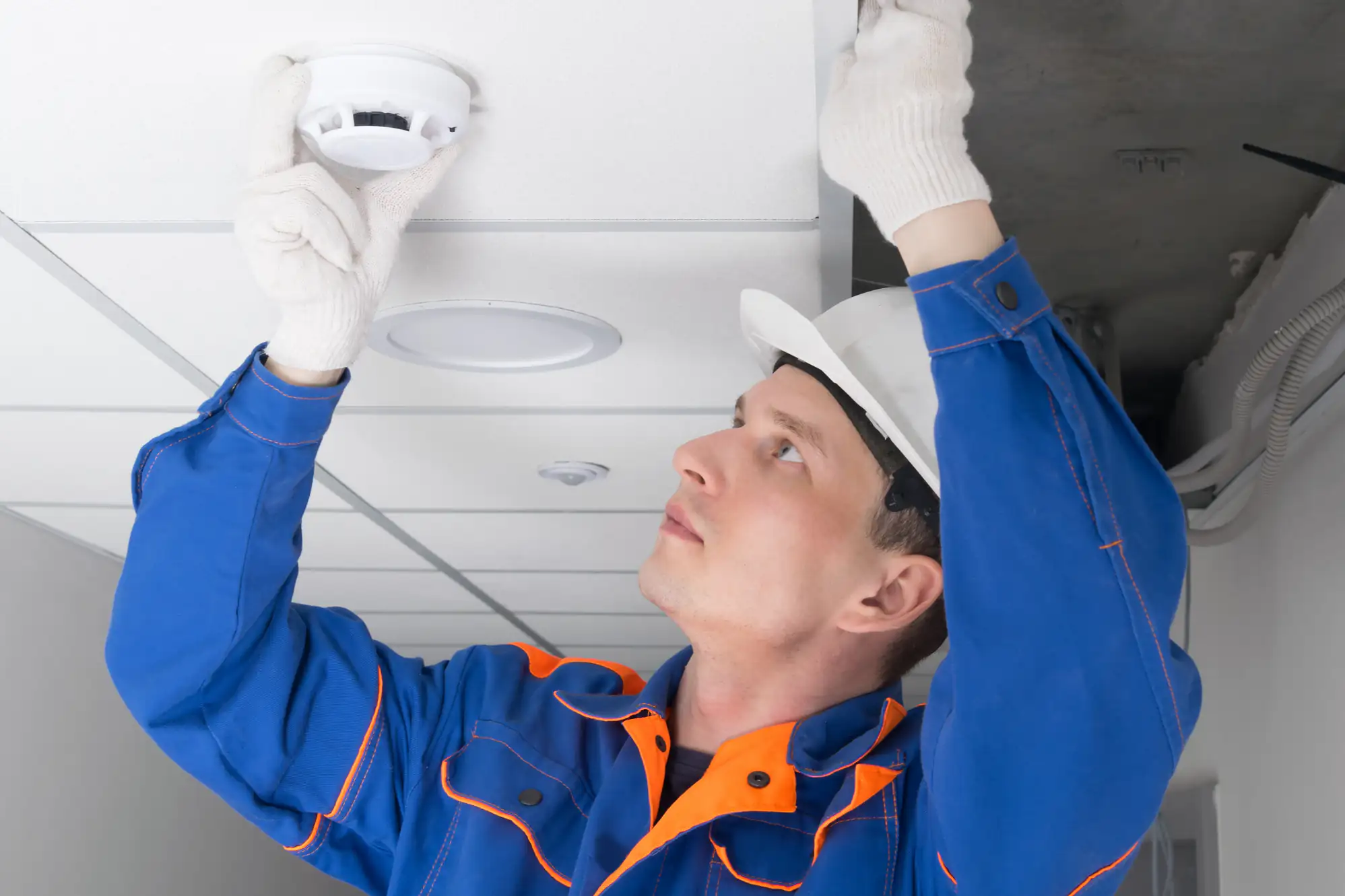
Ionization detectors respond quickly to fast-flaming fires — the kind that produce a lot of heat and light quickly. Photoelectric detectors are better at catching slow, smoldering fires that produce a lot of smoke before significant flames develop. Multi-sensor detectors combine both technologies, which is why they’re increasingly specified for commercial applications where you can’t always predict what type of fire event might occur.
For commercial kitchens and spaces near cooking equipment, there’s an additional consideration. The 2025 update to NFPA 72 requires that smoke detectors installed within 10 to 20 feet of cooking appliances comply with UL 217 (8th edition) or UL 268 (7th edition) standards for nuisance alarm resistance. This matters because a detector that triggers constantly during normal cooking operations trains occupants to ignore alarms — which is exactly the opposite of what a life safety system is supposed to do. Nassau County has a significant restaurant density along corridors like Hempstead Turnpike and Sunrise Highway, and this is a specification detail that comes up regularly in commercial kitchen buildouts.
Beyond detector type, ceiling height and airflow patterns affect how smoke moves through a space and how quickly a detector will respond. A warehouse with 30-foot ceilings needs a different detection strategy than a medical office with standard 9-foot ceilings. Occupancy classification also drives the requirement — what NFPA 72 and the Nassau County Fire Prevention Ordinance require for a school is different from what they require for a retail space, even if the buildings are the same size.
The bottom line is that “best” isn’t a product category — it’s the right product for the specific space, occupancy, and code requirement. That determination should be made by someone who knows Nassau County’s requirements, not someone guessing from a product catalog.
Choosing the Right Commercial Fire Protection System Starts With Knowing Your Code
The right commercial fire protection system isn’t the most expensive one, or the one a salesperson pushed hardest. It’s the one that matches your building’s occupancy, meets Nassau County’s specific requirements, and is installed and documented by qualified professionals who can stand behind it when the Fire Marshal shows up.
Nassau County’s enforcement posture is real. Violations happen regularly, and the consequences — failed inspections, corrective work orders, potential shutdowns — are expensive and disruptive. Getting the system right the first time is almost always cheaper than fixing it after a failed inspection.
If you’re trying to figure out what your building actually needs, Island Fire & Defense Systems is a good place to start. We know Nassau County’s code because we work in it every day — and we can tell you exactly what your property requires before you’re in a situation where you have to find out the hard way.