Summary:
If you’ve been searching for spray fireproofing costs and keep landing on price ranges that feel too clean to be real, you’re not imagining things. Most of those guides were written for national audiences — or worse, for markets where labor is half what it costs on Long Island.
Nassau County, NY has its own licensing requirements, its own Fire Marshal, and its own compliance environment. The number that matters isn’t what a Florida estimating site says — it’s what a properly licensed, locally approved contractor quotes for your specific building. This page gives you the context to understand that number before anyone puts it in front of you.
Spray Fireproofing Cost: What Nassau County Projects Actually Run
Here’s the honest answer: spray fireproofing in Nassau County, NY and the NYC metro area runs $5–$14 per square foot installed for cementitious spray-applied fire-resistive material (SFRM). Intumescent coatings — the kind used on exposed architectural steel — typically run $10–$30 per square foot.
Those ranges are wide on purpose. The actual cost depends on factors that no online calculator can account for without seeing your building: the type of steel, the required fire rating, how accessible the framing is, whether the existing substrate needs prep work, and which UL-listed assembly your project requires.
In Nassau County, local labor rates and permitting complexity push most projects toward the upper half of those ranges. That’s the reality of working in the metro area, and any contractor who quotes you significantly below it is worth questioning.
Fireproofing Services: Cementitious SFRM vs. Intumescent Coatings
These are the two main systems used in commercial fireproofing, and choosing the wrong one doesn’t just affect your budget — it can mean a failed inspection.
Cementitious SFRM is the workhorse of the industry. It’s a spray-applied mineral-based material that gets applied directly to structural steel, concrete, or other substrates. It’s cost-effective, durable in protected interior environments, and carries an indefinite service life when it’s left undisturbed. For concealed steel — the kind hidden above drop ceilings or inside wall cavities — cementitious SFRM is usually the right call.
It achieves 1-hour, 2-hour, and higher fire ratings depending on thickness and density, and those specs are tied to specific UL-listed assemblies that must be followed exactly.
Intumescent coatings work differently. When exposed to heat, they expand dramatically — sometimes up to 50 times their original thickness — forming a dense carbonaceous char that insulates the steel beneath. The result is fire resistance that can be applied thin enough to preserve the look of exposed structural steel. That’s why you see intumescent coatings in restaurants, retail spaces, open-plan offices, and modern mixed-use buildings where the steel is part of the design.
The tradeoff is cost: intumescent systems run meaningfully higher per square foot than cementitious SFRM, and they carry finite warranty periods — typically 10 to 25 years depending on exposure conditions — rather than the indefinite service life of a well-protected cementitious application.
One critical detail: you can’t mix intumescent products from different manufacturers on the same assembly. Each system is tested and listed as a complete unit. Swapping components from different brands isn’t just inadvisable — it invalidates the UL listing and can cause unpredictable behavior under fire conditions. This is exactly the kind of detail that separates experienced fireproofing contractors from those who treat it as a commodity trade.
What Drives Spray Fireproofing Cost Higher in Nassau County
The gap between what you read online and what you get quoted in Nassau County, NY comes down to a few compounding factors that national guides consistently ignore.
Labor is the biggest one. NYC metro labor rates are materially higher than the national averages that most cost guides are built on. When you see a range like “$2.40–$6.00 per square foot” cited for spray fireproofing, that number likely reflects markets in the Southeast or Midwest — not Long Island. Factor in prevailing wage requirements on public projects, union considerations on larger commercial jobs, and the general cost of doing business in the metro area, and the installed cost climbs.
Density requirements add another layer. SFRM isn’t a single product — it comes in commercial density (roughly 15–21 pounds per cubic foot), medium density (22–39 pcf), and high density (40+ pcf) formulations. The right density depends on the exposure conditions and the bond strength requirements set by the International Building Code. Buildings under 75 feet need SFRM with a bond strength of at least 150 pounds per square foot. Buildings between 75 and 420 feet require 430 psf. High-rises above 420 feet need 1,000 psf. Higher density means higher material cost — and Nassau County has plenty of mid-rise and high-rise commercial stock where those requirements apply.
Then there’s the compliance layer. Nassau County has its own Fire Prevention Ordinance — most recently updated by Ord. No. 59-2024, effective April 1, 2024 — that layers on top of the New York State Uniform Fire Prevention and Building Code. New York State adopted updated code aligned with 2024 ICC standards, with full enforcement expected by end of 2025. Projects that span Nassau County and NYC-adjacent areas also have to satisfy FDNY requirements. Navigating that dual-jurisdiction environment takes a contractor who knows both sets of rules — and that expertise has a real value that shows up in the quote.
Fireproofing and Compliance: What Nassau County Owners Get Wrong
The most common misconception we hear is that sprinklers and fireproofing are interchangeable — that if a building has a suppression system, the structural steel doesn’t need to be treated. That’s not how it works.
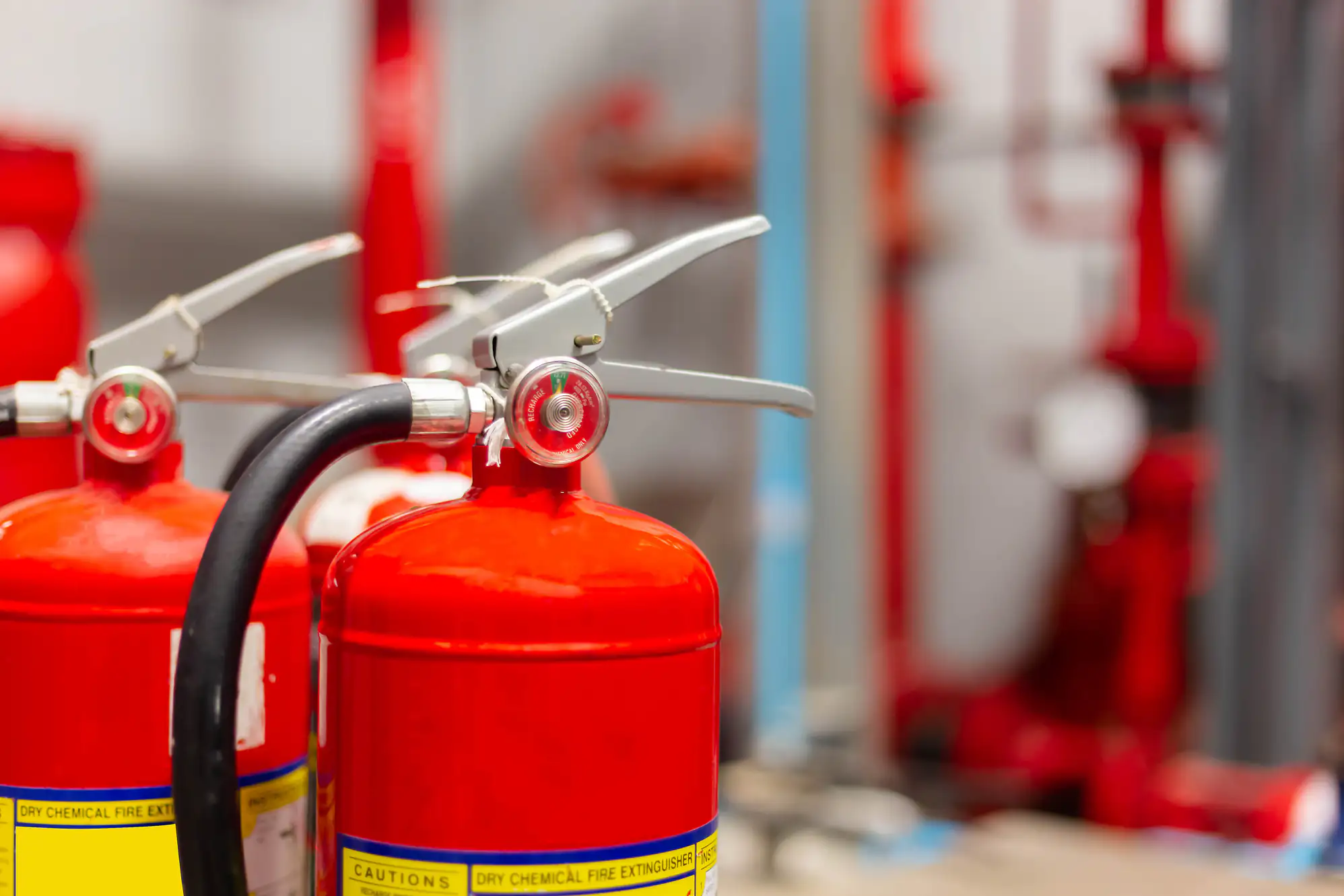
Sprinklers suppress fire. Fireproofing protects the structural steel from collapsing. Unprotected steel can reach critical failure temperature in as little as 10 minutes in a commercial fire. Properly applied SFRM buys 1 to 4 hours of structural integrity — time for occupants to evacuate and for firefighters to do their job.
Both systems are typically required by code in Nassau County. They serve different functions, and one does not substitute for the other. This distinction matters especially for older Nassau County buildings — the postwar commercial stock in areas like Hicksville, Mineola, and Garden City — where original fireproofing may be deteriorated, asbestos-containing, or simply absent from sections that were later renovated.
Does Your Nassau County Building Actually Need New Fireproofing?
It depends on what’s there now — and what’s changed recently. If your building is undergoing renovation, a change of occupancy, or an addition, current code requires that the affected structural elements meet today’s fire-resistance standards. That often means inspecting existing fireproofing for coverage, bond strength, and density compliance, and remediating where it falls short.
Cementitious SFRM in a protected interior environment can last the life of the building if it’s left undisturbed. The problem is that construction activity disturbs it. Drilling, cutting, patching, and even nearby trades working in the ceiling cavity can damage SFRM in ways that aren’t obvious until a special inspection reveals gaps in coverage or compromised bond strength. After any significant construction activity near fireproofed elements, an inspection is worth scheduling.
Coastal conditions are also a factor that’s easy to overlook. Nassau County’s proximity to the Atlantic Ocean and Long Island Sound creates elevated humidity environments, particularly in buildings with compromised envelopes. Moisture is one of cementitious SFRM’s main vulnerabilities — it can cause cracking, flaking, and in some cases corrosion of the underlying steel. Buildings along the South Shore and in areas with older building envelopes are more susceptible to this kind of deterioration than a typical inland structure would be.
If your building was constructed before the 1980s and has never had a fireproofing assessment, there’s a reasonable chance the original material contains asbestos. That doesn’t automatically mean it needs to come out — undisturbed asbestos-containing fireproofing is often left in place under an operations and maintenance plan — but any renovation that disturbs it triggers abatement requirements before new SFRM can be applied. That’s a cost driver that doesn’t show up in any per-square-foot estimate until someone actually looks at what’s there.
How to Evaluate a Fireproofing Contractor in Nassau County
Licensing in this space is specific, and “fully licensed and insured” isn’t enough information to go on. In Nassau County, fireproofing contractors need to hold county-level licenses — not just a state license. Working with a contractor who isn’t licensed at the county level can void inspections and create liability that lands back on the building owner. It’s worth asking for license numbers and verifying them before any work begins.
Beyond licensing, look for NICET certification. NICET — the National Institute for Certification in Engineering Technologies — is the recognized professional credential in fire protection. It signals that the technicians applying the material understand the engineering requirements behind it, not just the mechanics of operating a spray rig. The difference matters when the UL assembly specifies exact thickness tolerances that a third-party special inspector is going to verify.
Ask about the inspection process. Commercial fireproofing under the International Building Code requires third-party special inspection — thickness testing per ASTM E605, bond strength testing per ASTM E736. A contractor who can’t walk you through that process, or who seems unfamiliar with it, is a red flag. The inspection documentation is what stands between you and a violation order from the Nassau County Fire Marshal.
We hold Nassau County licenses 2019AEL75352 and PEL000000259, NYS License #12000325006, and we’re approved by both the Nassau County Fire Marshal and FDNY. Our team is NICET certified, and we handle fireproofing alongside fire alarm systems, suppression systems, and engineering drawings — all in-house. That matters for projects where the fireproofing specification has to be coordinated with alarm plans and structural drawings, which is most commercial projects of any real scope. Clients like NYU Langone, Starbucks, and Posillico have trusted us with exactly that kind of work.
Getting an Accurate Spray Fireproofing Cost Estimate in Nassau County
The ranges in this article are real — but your actual project cost depends on your steel configuration, required fire rating, building height, substrate condition, and local labor rates. No guide can give you a number worth budgeting around without a site assessment.
What this page can do is help you walk into that conversation prepared. You know the difference between cementitious SFRM and intumescent coatings. You know what drives cost variation in the Nassau County market. You know what questions to ask and what licensing to verify. That’s a better starting point than a national price list that was never written for Long Island.
If you’re ready to get an actual number for your project, Island Fire & Defense Systems offers free estimates and can assess what your building needs, what code requires, and what it will realistically cost — with no guesswork and no surprises when the fire marshal shows up.