Summary:
You’ve already decided you need a fire suppression system. Maybe you’re opening a new location, taking over a space from a previous tenant, or you just got flagged during an inspection. Either way, you’re not here for a lecture on why kitchen fires are dangerous. You’re here because you have a real decision to make and you want to make it correctly the first time.
The wet chemical vs. water mist question trips up a lot of restaurant operators — not because it’s complicated, but because most of the information out there is generic. It doesn’t account for what Nassau County, NY actually requires, what local installation costs look like, or why the system type matters less than who installs it. Let’s fix that.
Restaurant Fire Suppression System Installation: What the Process Actually Looks Like in Nassau County
A lot of restaurant operators assume installation is straightforward — a crew shows up, mounts the system, and you’re done. In reality, the process has several steps, and where things go wrong is usually in the gaps between them.
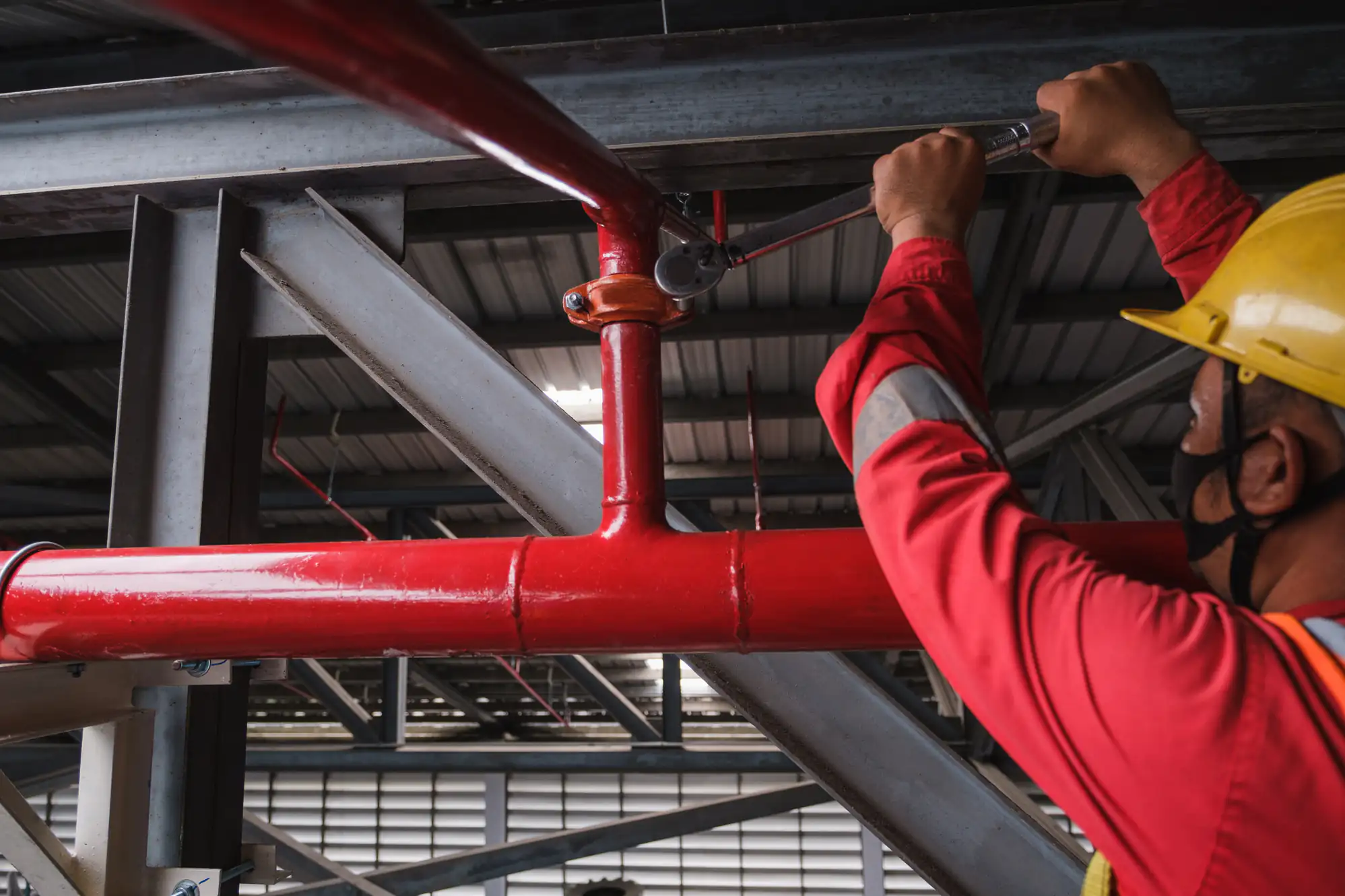
A proper restaurant fire suppression system installation starts with a site assessment and system design. From there, engineering drawings are produced and submitted for permitting through the Nassau County Fire Marshal’s office. Once permits are approved, installation begins, followed by commissioning — which means testing the system as actually installed, not just confirming the parts are there. After that comes the AHJ inspection, and then staff training so your team knows how to respond if the system activates.
That last step, training, is one most contractors skip. It matters more than people realize.
Water Mist Fire Suppression Systems: How They Work and When They Make Sense
Water mist systems suppress fire by atomizing water into extremely fine droplets — under 200 microns — and releasing them at high pressure. Those tiny droplets do three things simultaneously: they cool the flame, they displace oxygen as they vaporize, and they block radiant heat from spreading the fire. It’s genuinely effective technology, and it has real advantages in certain environments.
The appeal for restaurant operators is understandable. Water feels safer than a chemical agent. Cleanup after an accidental discharge seems simpler. And if you’ve read anything about water mist in the past few years, you’ve probably seen it described as a modern alternative to older suppression methods.
Here’s what that coverage usually leaves out: water mist is governed by NFPA 750, and it is not universally accepted by Authorities Having Jurisdiction for commercial kitchen hood suppression. In Nassau County, NY specifically, wet chemical — listed to UL 300 — is the standard that the Nassau County Fire Marshal enforces for kitchen hood applications under NFPA 96. Before specifying a water mist system for a kitchen hood, you’d need to confirm directly with the AHJ that they’ll accept it. Most of the time, for a standard restaurant kitchen, they won’t.
Water mist does have legitimate use cases. Heritage buildings where chemical cleanup would cause secondary damage to the structure, specialty applications where the cooking equipment doesn’t involve open-flame grease cooking, or environments where the specific hazard profile supports it. But for the typical Nassau County restaurant with a commercial hood over fryers, griddles, or ranges, wet chemical is what the code requires and what we’ll specify.
The cost difference is also significant. Water mist systems for restaurant applications start around $8,000 to $15,000 or more installed. A wet chemical system for a standard restaurant kitchen hood runs $3,500 to $8,500 installed, depending on kitchen size, number of hoods, and equipment configuration. That’s not a small gap, and it matters when you’re comparing quotes.
Why Wet Chemical Is the Code-Required Standard for Nassau County Restaurant Kitchens
Wet chemical systems work through a process called saponification. When the potassium-based agent contacts burning cooking oil, it triggers a chemical reaction that converts the surface of the oil into a thick, soap-like foam. That foam smothers the flame, cools the surface below ignition temperature, and prevents reflash — the re-ignition that happens when a fire appears to be out but the oil is still hot enough to reignite. Cooking oil fires can reach temperatures above 700°F. Water alone would cause a steam explosion at those temperatures. Wet chemical is specifically engineered for this hazard.
NFPA 96 — the national standard for commercial cooking fire protection — requires that kitchen hood suppression systems be listed to UL 300. Wet chemical systems meet that listing. The 2024 and 2025 editions of NFPA 96 also eliminated the grandfather clauses that used to allow older dry chemical systems to remain in service. If your restaurant is still running a pre-UL 300 dry chemical system, you are now out of compliance and will need to upgrade. This isn’t a future concern — it’s current.
Nassau County operates under centralized fire code oversight through the Nassau County Fire Marshal’s office, which enforces NFPA 96 across the county. This is different from Suffolk County, where 109 independent fire districts each apply their own interpretation of the code. In Nassau County, the rules are consistent, but the Fire Marshal’s office is the gatekeeper — and the contractor you hire needs to be specifically approved to pull permits and perform inspections there. Not every fire protection company operating on Long Island holds that approval.
Many restaurants in Nassau County operate in strip malls, converted storefronts, and mixed-use buildings — not purpose-built restaurant spaces. Those configurations often require more complex system design than a standard layout, which is exactly why having engineering drawings produced correctly the first time matters so much.
Restaurant Fire Suppression System Cost: What Nassau County Operators Should Expect
Cost is the question everyone has and almost no one answers clearly. Here’s what the numbers actually look like for a restaurant kitchen suppression system in the Nassau County market.
A wet chemical system for a standard restaurant kitchen hood runs between $3,500 and $8,500 installed. A single 6-foot hood setup falls toward the lower end of that range; a double hood system runs closer to $6,000 to $8,500. Those figures cover equipment and installation labor, but they don’t include permit and engineering fees, which vary based on your kitchen’s configuration and our process. After installation, NFPA 96 requires semi-annual inspections — every six months — by a licensed contractor. Inspection costs typically run $200 to $400 per inspection event.
Commercial Kitchen Fire Suppression System Cost: What Drives the Price Up or Down
Several variables move the cost of a commercial kitchen fire suppression system significantly in either direction. Kitchen size is the obvious one — more cooking equipment means more coverage area, more nozzles, and a larger agent cylinder. But the type of cooking equipment matters just as much as the quantity. Fryers require different nozzle placement and agent coverage than griddles or ranges. A system that’s correctly sized for a griddle may not adequately cover a bank of fryers positioned differently than what the original design assumed.
The number of hoods is another factor. A single-hood kitchen is straightforward. A kitchen with multiple hoods, separate exhaust zones, or cooking equipment spread across different stations requires a more complex design — and a more detailed set of engineering drawings to get through the permitting process cleanly.
This is where the engineering piece becomes a real cost variable, not just a process detail. When a contractor outsources engineering drawings to a separate firm, you’re adding a coordination layer. If the drawings don’t precisely match the installed system — which happens more often than it should — the inspection fails. Then you’re paying for re-inspection, potentially re-engineering, and the delay that comes with both. For a restaurant that’s trying to open on schedule or avoid a closure order, that’s not a theoretical risk. It’s a real one.
We produce engineering drawings in-house at Island Fire & Defense Systems. The same team that designs the system installs it and submits the documentation. There’s no handoff between a drawing firm and an installation crew, and no gap where something gets lost in translation. For Nassau County restaurants, that means one permit application, one point of contact, and a significantly lower chance of a drawing-to-installation mismatch that causes an inspection failure.
The cost of not getting this right is also worth naming plainly. A restaurant kitchen fire causes an average of $23,000 in direct property damage and three to eight weeks of business closure. More than half of food service businesses that experience a significant fire never reopen. The suppression system cost, including installation and ongoing inspections, is a fraction of that exposure.
What to Ask a Nassau County Fire Suppression Contractor Before You Hire Them
Most restaurant operators request two or three quotes and then struggle to compare them because the quotes don’t cover the same scope. One includes engineering drawings; another doesn’t. One assumes a single hood; another accounts for the actual kitchen layout. Without a baseline, it’s almost impossible to know whether a lower price reflects efficiency or corners being cut.
A few questions worth asking any contractor before you commit:
Are you approved by the Nassau County Fire Marshal? This is not the same as holding a New York State license. Nassau County requires jurisdiction-specific approval to pull permits and perform inspections in the county. If a contractor can’t confirm they hold Nassau County licenses — verifiable, specific license numbers — that’s a significant red flag.
Do you produce engineering drawings in-house, or do you outsource them? The answer tells you a lot about how the project will be managed and whether you’re at risk of a drawing-installation mismatch at inspection time.
What certifications do your technicians hold? NICET certification is the nationally recognized standard for fire alarm and suppression system technicians. It’s not the only credential that matters, but it’s a meaningful one. Manufacturer certifications — like ProTex II distributor status for wet chemical systems — indicate factory-level training on the specific system being installed, not just general installation experience.
What does the semi-annual inspection relationship look like after installation? NFPA 96 requires inspections every six months. The contractor who installs your system is ideally the same one performing those inspections — they know the system’s history, they know how it was configured, and they’re not starting from scratch every time.
We hold Nassau County licenses 2019AEL75352 and PEL000000259, are approved by the Nassau County Fire Marshal, and carry NICET certification across our team. We’re also a ProTex II Certified Distributor and an authorized Amerex dealer, which matters specifically for commercial kitchen suppression applications. Starbucks has trusted us across multiple locations — a brand with national vendor standards and a rigorous approval process. That reference point tends to mean something to restaurant operators who know what it takes to meet a demanding client’s requirements.
Choosing the Right Restaurant Fire Protection System in Nassau County
For most Nassau County restaurants, wet chemical is the correct system — it’s what NFPA 96 requires, it’s what the Nassau County Fire Marshal enforces, and it’s what’s specifically engineered for the grease fire hazard that commercial kitchens produce. Water mist has its place, but that place is not a standard kitchen hood application, and the cost premium is substantial.
What matters as much as the system type is who installs it. In-house engineering, jurisdiction-specific licensing, and NICET-certified technicians aren’t marketing language — they’re the difference between a system that passes inspection the first time and one that doesn’t.
If you’re evaluating your options for a new location, an upgrade, or an inherited system you’re not sure about, Island Fire & Defense Systems is worth a conversation. We serve Nassau County restaurants directly and handle everything from design and permitting through installation, inspection, and staff training.