Summary:
You’ve reset the panel. Maybe you’ve swapped a battery. And it’s still beeping. If you manage a commercial building in Nassau County, NY, that sound is probably following you around your property and into your sleep. The good news: a beeping fire alarm usually isn’t a sign of an active emergency. The not-so-good news: it’s not something you can keep silencing and walking away from either. This post covers the real reasons commercial fire alarms beep — including one cause most people never think to check — and what it means for your building’s compliance standing under Nassau County’s fire code.
Ionization Smoke Alarm Technology and Why It Beeps More Than You'd Expect
Not all smoke detectors work the same way, and the type installed in your building has a direct impact on how often it beeps, chirps, or triggers a false alarm. Ionization smoke alarms use a small amount of radioactive material to ionize air inside a detection chamber. When smoke particles enter that chamber, they disrupt the electrical current and trigger the alarm. These detectors are generally faster at detecting fast-flaming fires — the kind that spread rapidly with open flames.
The problem is that ionization detectors are also highly sensitive to particles that aren’t smoke from a fire. Steam from a commercial kitchen, humidity near an HVAC discharge point, dust from a renovation project, and even exhaust from a loading dock can all set them off. In Nassau County’s dense commercial corridors — the strip malls along Hempstead Turnpike, the medical offices near Jericho Turnpike, the mixed-use buildings along Route 25A — these environmental triggers are everywhere. If your ionization detector is placed near any of these sources, chronic beeping is almost inevitable.
Photoelectric Smoke Alarms: A Better Fit for Most Commercial Environments
Photoelectric smoke alarms work differently. Instead of ionizing air, they use a light beam inside a sensing chamber. When smoke enters, it scatters that light onto a sensor, triggering the alarm. This technology responds faster to slow, smoldering fires — the type more common in commercial settings where materials like upholstery, wiring insulation, or stored inventory can smolder for a long time before producing open flames.
More importantly for the beeping conversation: photoelectric detectors are significantly less prone to nuisance alarms from cooking, steam, and airborne dust. If your building has been dealing with chronic false alarms or persistent fault signals, and your detectors are ionization-type units installed near a kitchen, a bathroom exhaust, or a mechanical room, that mismatch is almost certainly contributing to the problem.
Research cited by the NFPA shows that just three nuisance alarms per year is enough to seriously erode how occupants respond to alarms. At that threshold, people start assuming every alarm is a false one — they hesitate, they don’t evacuate, and in a real emergency, that delay costs lives. A beeping alarm isn’t just an operational headache. Over time, it’s a behavioral risk.
Dual-sensor detectors — which combine both ionization and photoelectric technology — are increasingly common in commercial spaces where the fire risk profile is mixed. They reduce nuisance alarms while maintaining sensitivity to both fast-flaming and smoldering fires. If your current system was installed years ago without much thought given to detector placement or technology type, a full evaluation is the only way to know whether you have the right detectors in the right locations.
Photoelectric Fire Alarm Placement: Where the Detector Goes Matters as Much as What It Is
Even the right detector in the wrong location will cause problems. A photoelectric fire alarm installed directly in the path of an HVAC vent can still trigger false alarms from temperature swings and airborne particulates. A detector mounted too close to a commercial kitchen — within ten to twenty feet of cooking appliances — faces the same challenge, which is why the 2025 update to NFPA 72 now requires detectors in those zones to meet updated UL standards specifically designed to resist nuisance alarms from cooking activity.
In older Nassau County, NY commercial buildings — and there are a lot of them, particularly along the major corridors that developed in the postwar decades — detector placement was often done to meet the code of the time, not today’s standards. Systems that passed inspection fifteen years ago may now have detectors in positions that generate chronic fault signals simply because the building’s use has changed: a storage room became a kitchen, an open floor plan got divided with new walls, or an HVAC upgrade changed airflow patterns throughout the space.
This is why resetting the panel rarely solves the underlying problem. The reset clears the fault signal temporarily, but if the cause is environmental — a detector in a steam-prone area, a unit caked with construction dust from a recent renovation, or an aging sensor whose sensitivity has drifted outside the range required by NFPA 72 — the signal will return. NFPA 72 requires smoke detector sensitivity testing within the first year of installation and every two years after that. Detectors found outside their listed sensitivity range must be cleaned, recalibrated, or replaced. If that testing hasn’t been done, you may be running a system that’s out of compliance and generating fault signals for reasons that a simple walk-through won’t catch.
Types of Smoke Alarms and What a Beeping Panel Means for Your Compliance
Understanding the types of smoke alarms in your building is step one. Understanding what a beeping panel means for your compliance standing is step two — and it’s the part most facility managers don’t think about until an inspector shows up.
A fire alarm panel that is beeping is generating a documented fault signal. That’s not an interpretation — that’s how NFPA 72 defines it. Every deficiency found during inspection or flagged by the system itself must be documented: when it was discovered, what the nature of the deficiency is, what corrective action was taken, and when it was resolved. Unresolved deficiencies must be tracked until they’re closed.
Nassau County Fire Code and What an Unresolved Fault Signal Can Cost You
Nassau County, NY operates under centralized Fire Commission oversight — which is different from how fire code enforcement works in Suffolk County, where requirements vary town by town. In Nassau County, the rules are uniform and consistently enforced. Fire alarms are required for all commercial occupancies, and that requirement extends to renovations, not just new construction. The Nassau County Fire Marshal has real authority over your system’s compliance status, and an unresolved fault signal is a documented problem that can surface during any scheduled or unannounced inspection.
What that means practically: if your panel has been beeping for weeks and you’ve been silencing it without having a licensed technician diagnose and document the fault, you may be accumulating a compliance exposure you’re not aware of. It’s not just about the beep. It’s about what the beep represents in writing — a known deficiency that hasn’t been corrected.
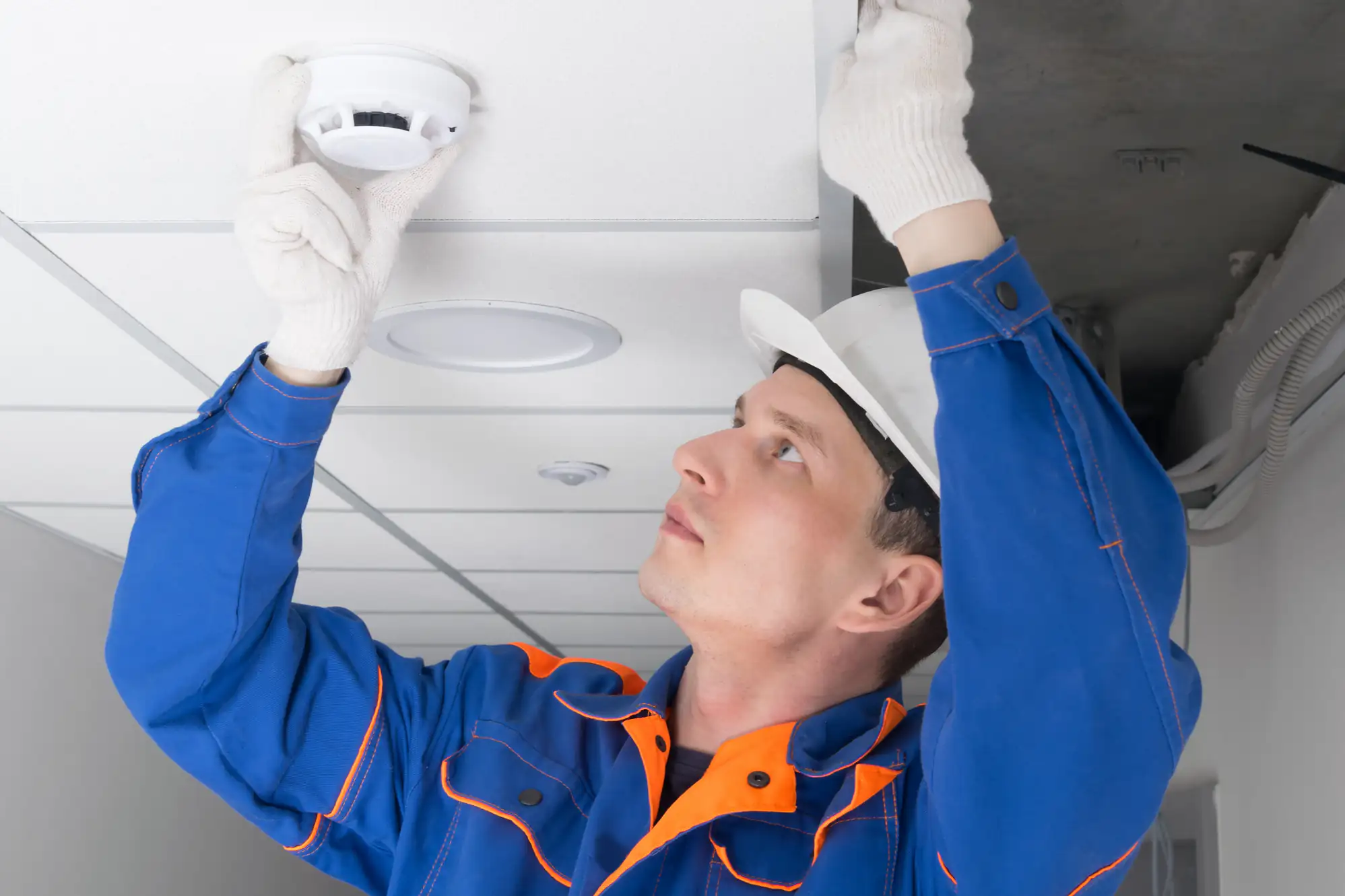
This is also why the technician you call matters. NFPA 72 Chapter 10 requires qualified personnel for system inspection and testing. NICET Fire Alarm Systems certification is the standard that meets most jurisdictional requirements — it means the technician is trained to properly diagnose system faults, document findings in a format that satisfies code review, and recommend corrective action that will actually hold up if the Nassau County Fire Marshal reviews your records. A technician who resets your panel and hands you a receipt isn’t the same as a NICET-certified professional who identifies the root cause, documents the fault, and closes it correctly.
When Should You Call a Licensed Fire Alarm Technician in Nassau County?
The short answer: sooner than most building managers do. If your panel won’t stay reset — meaning the fault signal returns within hours or days of being cleared — that’s a sign the underlying cause hasn’t been identified. A reset is not a repair.
If you’re seeing an error code on the panel that you don’t recognize, don’t try to interpret it from a manual. Commercial fire alarm control panels vary significantly by manufacturer and model, and misreading a fault code can lead you to replace the wrong component while the real problem continues.
If your building has detectors that are approaching or past the ten-year mark, that’s another trigger. NFPA recommends replacing commercial smoke detectors at that interval, and in high-particulate environments — commercial kitchens, woodworking shops, facilities with heavy foot traffic — the timeline can be shorter. An aging detector’s sensitivity drifts, its internal chamber collects residue, and its components degrade. At some point it stops being a reliable life-safety device and starts being a source of chronic nuisance alarms.
If your building has recently gone through a renovation, construction dust is one of the leading causes of false alarms and fault signals in commercial systems. Even a modest interior renovation can introduce enough particulate matter to push detectors outside their sensitivity range. That’s a reason to have the system evaluated before the dust settles — literally — and before a Nassau County inspection catches it first.
We hold Nassau County licenses 2019AEL75352 and PEL000000259, and our team is approved by the Nassau County Fire Marshal. Our technicians are NICET certified, which means when we diagnose a fault, document a deficiency, or recommend a detector replacement, the paperwork will hold up under code review. We’ve worked on complex commercial systems throughout Nassau County, and we bring that same level of documentation and precision to every service call — whether it’s a single beeping detector or a full system evaluation.
What to Do Next If Your Commercial Fire Alarm Keeps Beeping
A beeping fire alarm in a commercial building is almost never just a dead battery. It’s a fault signal — and in Nassau County, NY, a fault signal that goes unresolved is a compliance problem waiting to become a bigger one. Whether the cause is an aging ionization detector in the wrong environment, a sensitivity issue flagged by NFPA 72 testing requirements, or a placement problem that’s been generating nuisance alarms for years, the fix starts with an honest diagnosis, not another reset.
If the beeping in your building has become a pattern, reach out to Island Fire & Defense Systems. We’ll identify what’s actually causing it, document it properly, and give you a clear path to getting your system back into compliance — before the Nassau County Fire Marshal does it for you.