Summary:
If you’re searching for fire extinguisher inspection costs, you’re probably looking for a number you can budget around — or you’ve just received a violation notice and need to fix it fast. Either way, you’re in the right place.
The honest answer is that annual inspections for standard extinguishers run $40 to $100 per unit, with Nassau County providers typically charging a service minimum of $80 to $150 per visit on top of per-unit fees. But the more useful answer involves understanding what you’re actually required to do, when, and what happens if you don’t. That’s what this guide covers.
Fire Extinguisher Inspection Requirements in Nassau County, NY
Nassau County operates under a centralized fire safety structure governed by the Nassau County Fire Commission and enforced by the Nassau County Fire Marshal’s Office. That means every commercial property in Hempstead, Garden City, Mineola, Oyster Bay, Hicksville, Westbury, and across Nassau County faces the same inspection standards — uniformly enforced, year-round.
New York State adopts NFPA 10 (Standard for Portable Fire Extinguishers) through Title 19 NYCRR 1225. Nassau County’s Fire Prevention Ordinance supplements that with its own contractor licensing requirements — meaning not every fire protection company operating in New York State is legally authorized to service extinguishers in Nassau County. The contractor must hold a valid Type 2 License for Inspection, Testing and Maintenance from the Nassau County Fire Marshal’s Office, and the technician performing the work must hold a Certificate of Fitness for that same scope of work.
That’s worth knowing before you accept the lowest quote you find online.
Annual Fire Extinguisher Inspection Requirements: What the Law Actually Requires
NFPA 10 establishes four distinct service intervals for portable fire extinguishers, and each one has different requirements for who can perform it and what it involves. Most business owners are aware of the annual inspection — but fewer understand how the full schedule works or what they’re on the hook for beyond that yearly tag swap.
The monthly visual inspection is the one you can actually perform yourself. It covers the basics: is the extinguisher accessible, is the gauge in the green zone, is the safety pin intact, is there any visible damage? NFPA 10 allows the building owner or a designated employee to handle this, and it doesn’t require a certified technician. That said, documenting it matters — a log of monthly checks is part of what a fire marshal wants to see.
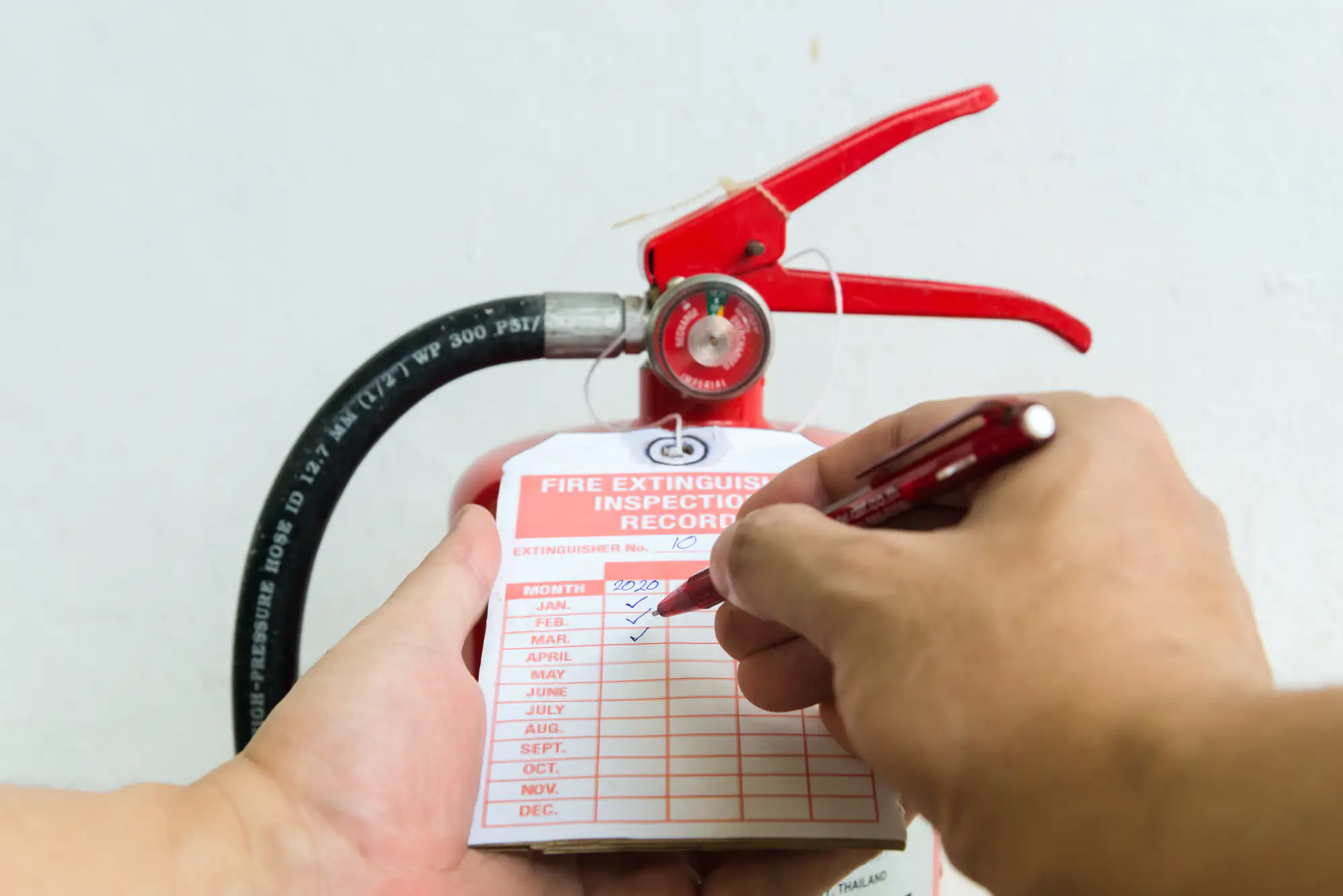
The yearly fire extinguisher inspection is a different story. This annual maintenance examination must be performed by a certified fire protection technician. It goes beyond what you can see from across the room — it includes a detailed check of the hose and nozzle, the tamper seal, the label and signage, the pressure gauge, and the overall mechanical condition of the unit. The technician documents findings and issues a tagged record that must remain with the extinguisher. If deficiencies are found, they need to be corrected before the unit is returned to service.
For standard ABC dry chemical extinguishers — the most common type in Nassau County commercial properties — annual inspections typically run $40 to $100 per unit. Specialized units like wet chemical (Class K) extinguishers, which are required in commercial kitchens, can cost up to $300 per unit due to the additional expertise involved. Most Nassau County providers structure their pricing as a service minimum of $80 to $150 per visit, plus a per-unit fee on top. A facility with 25 units can expect to pay roughly $1,000 to $1,500 for annual inspections.
The documentation quality matters as much as the inspection itself. A technician who shows up, swaps a tag, and leaves isn’t giving you what the Nassau County Fire Marshal actually wants to see. You need a detailed inspection report with documented deficiencies and corrective actions — not just a new sticker.
Fire Extinguisher 6-Year Maintenance and 12-Year Hydrostatic Testing
The annual inspection is what most people think about, but NFPA 10 also requires two additional service intervals that carry higher costs and are more involved than a standard yearly visit.
The 6-year internal examination applies to stored-pressure extinguishers and requires the unit to be fully depressurized and opened so a certified technician can inspect the internal components — looking for corrosion, agent caking, valve degradation, and anything else that wouldn’t be visible from the outside. This is why “it looks fine” isn’t a reliable standard. An extinguisher can pass every visual check and still fail under actual fire conditions if the internal components have deteriorated. The 6-year fire extinguisher inspection must be performed by a certified facility, not just any licensed contractor.
The 12-year hydrostatic test goes further — the cylinder itself is pressure-tested to verify its structural integrity under load. This requires specialized equipment and typically means the extinguisher is sent to a testing facility for several days. Hydrostatic testing runs $40 to $70 per unit in Nassau County. If the cylinder fails the test, the extinguisher must be replaced.
For business owners who’ve been using the same extinguishers for years, it’s worth checking where you are in the cycle. An extinguisher that passed its last annual inspection may still be overdue for its 6-year internal exam — and if a fire marshal catches that during a commercial property sweep, the violation fine runs $300 to $1,000 per extinguisher. That math makes the cost of proper maintenance look very different.
The fire extinguisher maintenance schedule isn’t optional or flexible. These intervals are set by NFPA 10 as adopted by New York State law, and Nassau County enforces them. Skipping the 6-year or 12-year service doesn’t just create a compliance gap — it creates a liability exposure that no business owner wants to carry.
Fire Safety for Restaurants in Nassau County: Beyond the Portable Extinguisher
If you run a restaurant along Hempstead Turnpike, Sunrise Highway, Jericho Turnpike, or anywhere else on Nassau County’s commercial corridors, portable fire extinguisher compliance is only part of what you’re required to maintain. The fire safety picture for a restaurant includes a second, separate compliance obligation that operates on its own inspection schedule — and many restaurant owners don’t find out about it until they fail a fire marshal inspection.
Any commercial kitchen operating under a Type I hood — which covers virtually every restaurant, diner, catering hall, and food service operation in Nassau County — is required under NFPA 96 to have an automatic fire suppression system. That system has its own inspection and maintenance requirements, its own service intervals, and its own cost structure. A provider who only handles portable extinguishers can’t cover both.
Fire Protection for Restaurants: What NFPA 96 Requires
NFPA 96 is the standard governing commercial kitchen ventilation and fire suppression systems, and it applies to every restaurant in Nassau County regardless of size. The 2025 edition made a significant change worth knowing about: it eliminated grandfather clauses for pre-UL 300 dry chemical suppression systems. If your kitchen is still running an older dry chemical hood system, you may now be facing insurance claim denials — not just a compliance flag, but an actual gap in coverage if a fire occurs.
Restaurant fire protection systems fall into two main categories. Wet chemical systems, which use a potassium-based agent that reacts with cooking oils and fats to suppress fire and prevent re-ignition, are the current standard for commercial cooking equipment. Dry chemical systems are older technology and are being phased out under the updated NFPA 96 requirements.
Beyond the type of system, restaurant owners need to understand the inspection schedule. Commercial kitchen fire suppression systems typically require inspection every six months — or quarterly in some jurisdictions — at a cost of $200 to $400 per inspection. That’s a separate line item from your annual portable extinguisher inspection, and it requires a provider who is certified to service suppression systems, not just extinguishers.
The fire suppression system requirement also means that when a system discharges — whether from an actual fire or an accidental activation — the entire system must be professionally reset, recharged, and re-inspected before the kitchen can return to service. That’s not a situation where you want to be finding a provider for the first time.
Commercial Kitchen Fire Suppression System Cost in Nassau County
Restaurant fire suppression system installation costs vary based on the size of the kitchen, the number of hood stations, and whether you’re doing new construction or retrofitting an existing setup. For a standard single or double hood configuration — which covers most Nassau County restaurants — installed costs typically run $3,500 to $8,500. Larger or multi-station kitchens can exceed that range significantly.
The restaurant fire suppression system installation process involves more than just the suppression unit itself. It includes the hood and duct system, the fuel shutoff mechanism (which automatically cuts gas to the cooking equipment when the system activates), the nozzle placement and coverage design, and the permit and inspection process with Nassau County. Because Nassau County requires specific contractor licensing for this work, the provider you choose needs to hold the right credentials — not just a general contractor’s license.
For restaurant owners weighing the cost, it helps to put the numbers in context. The average restaurant kitchen fire causes $23,000 in direct damage and results in three to eight weeks of closure, with lost revenue averaging $40,000 to $120,000 during that period. A properly installed and maintained suppression system is what stands between a contained cooking fire and that outcome. It’s also what your insurance carrier is looking at when they decide whether a claim is covered.
We handle the full scope of restaurant fire protection across Nassau County — from portable extinguisher inspection and recharge to commercial kitchen fire suppression system installation, inspection, and maintenance. Our technicians are NICET-certified, and we hold Nassau County licenses 2019AEL75352 and PEL000000259, along with approval from the Nassau County Fire Marshal. We’re also authorized Amerex and Badger extinguisher dealers, which means genuine parts and manufacturer support for every service we perform. For restaurants across Nassau County, Queens, and the broader Long Island area, that means one provider who can keep the entire fire safety picture current — no coordination gaps, no missed intervals.
Fire Extinguisher Inspection Schedule: What Nassau County Businesses Should Do Next
The fire extinguisher inspection cost question has a straightforward answer: annual maintenance for standard units runs $40 to $100 per extinguisher, with Nassau County service minimums typically between $80 and $150 per visit. The 6-year internal exam and 12-year hydrostatic test add to that over time. For restaurants, add the cost of bi-annual suppression system inspections and, if you’re overdue, the cost of bringing an older system up to current NFPA 96 standards.
What’s less straightforward is making sure the provider you hire is actually authorized to do this work in Nassau County. The county’s licensing requirements go beyond the state level — and a tag from an unlicensed provider won’t satisfy a Nassau County Fire Marshal inspection, no matter how official it looks.
If you’re not sure where you stand on your inspection schedule, or you’ve received a violation notice and need to move quickly, we serve Nassau County, Suffolk County, and New York City with the full licensing stack and NICET-certified technicians to handle every interval — from the annual tag to the 12-year hydrostatic test. Reach out and we’ll tell you exactly what you need.
—
**FAQs**
**Where to get fire extinguisher inspected in Nassau County, NY?** In Nassau County, fire extinguisher inspections must be performed by a contractor holding a valid Type 2 License for Inspection, Testing and Maintenance from the Nassau County Fire Marshal’s Office — and the technician must hold a Certificate of Fitness for that work. This is a Nassau County-specific requirement on top of New York State licensing. Not every fire protection company you’ll find online holds both. Before scheduling, ask the provider for their Nassau County license number and verify it with the Fire Marshal’s Office. We hold Nassau County licenses 2019AEL75352 and PEL000000259 and are approved by the Nassau County Fire Marshal.
**Where can I get fire extinguishers inspected on Long Island or in Queens, NY?** For fire extinguisher inspection on Long Island — including Nassau County and Suffolk County — and in Queens and the broader New York City area, you need a provider licensed in each jurisdiction you operate in. Nassau County, Suffolk County, and the FDNY each have their own licensing and approval requirements. We hold active licenses in all three jurisdictions, including NYS License #12000325006, Nassau County licenses, Suffolk County license #180, and FDNY approval — so whether you’re managing a property in Hempstead, a location in Freeport, or a second site in Queens, we can cover all of it under one relationship.
**What does an overcharged fire extinguisher mean — and is it dangerous?** An overcharged extinguisher is one where the pressure gauge needle has moved into the red zone above the normal operating range. It’s not “better” because it has more pressure — it’s actually a safety hazard. An overcharged unit can rupture or discharge unexpectedly, which creates both a physical risk and a compliance problem. If you notice a gauge reading above the green zone, take the extinguisher out of service immediately and have it inspected by a certified technician. Do not attempt to release pressure yourself. A licensed fire protection professional can assess whether the unit can be corrected or needs to be replaced.