Summary:
Here’s something most facility managers learn the hard way: a clean inspection from last year doesn’t mean you’re compliant today. Nassau County has ongoing maintenance requirements — quarterly, semi-annual, and annual — and if you’re only thinking about fire safety once a year, there are almost certainly gaps you haven’t caught yet.
Q4 is when everyone rushes to schedule inspections at the same time. Service companies fill up fast. If you’re reading this in the fall and haven’t started, you may already be behind. This checklist is designed to help you figure out where you stand, what needs to happen, and how to get ahead of it before the calendar works against you.
Fire Safety Tips for Nassau County Facility Managers
The most useful fire safety tips aren’t the generic ones. They’re the ones that account for where you are and what’s actually required of you. Nassau County operates under its own Fire Prevention Ordinance, enforced by the Nassau County Fire Commission — not NYC fire code, not generic state minimums. If you’ve ever managed a property in the five boroughs and assumed the rules carry over, they don’t. Nassau County has its own licensing requirements, its own inspection cadence, and its own enforcement structure.
One of the most common things we see is a facility that passed inspection two years ago and hasn’t touched anything since. The problem is that compliance isn’t a one-time event. Some systems require attention every quarter. Others require semi-annual checks. And a few items — like smoke detector replacement — have deadlines tied to manufacture dates that most building owners have never looked at.
What a Commercial Fire Inspection Service in Nassau County Actually Covers
A professional fire inspection service isn’t just someone walking the building with a clipboard. In Nassau County, contractors must hold a Type 2 License for Inspection, Testing and Maintenance issued by the Nassau County Fire Marshal’s Office. Technicians need a Certificate of Fitness on top of that. If the company you’re using isn’t specifically licensed for Nassau County work, any documentation they produce may not hold up when the Fire Marshal asks to see it.
What a proper inspection covers depends on what systems you have, but for most commercial buildings it includes the fire alarm control panel, every detection device and notification appliance in the building, the sprinkler system and its control valves, fire extinguishers, emergency lighting, and fire-rated door assemblies. That’s not a once-over — each of those systems has its own code-mandated testing frequency under NFPA 72, NFPA 25, NFPA 10, NFPA 101, and NFPA 80.
The documentation piece matters as much as the testing itself. A good inspection produces written reports you can present to the Authority Having Jurisdiction on request, hand to your insurance carrier, and file internally. If something goes wrong and you can’t produce inspection records, the liability exposure can far exceed the cost of whatever violation you were trying to avoid in the first place.
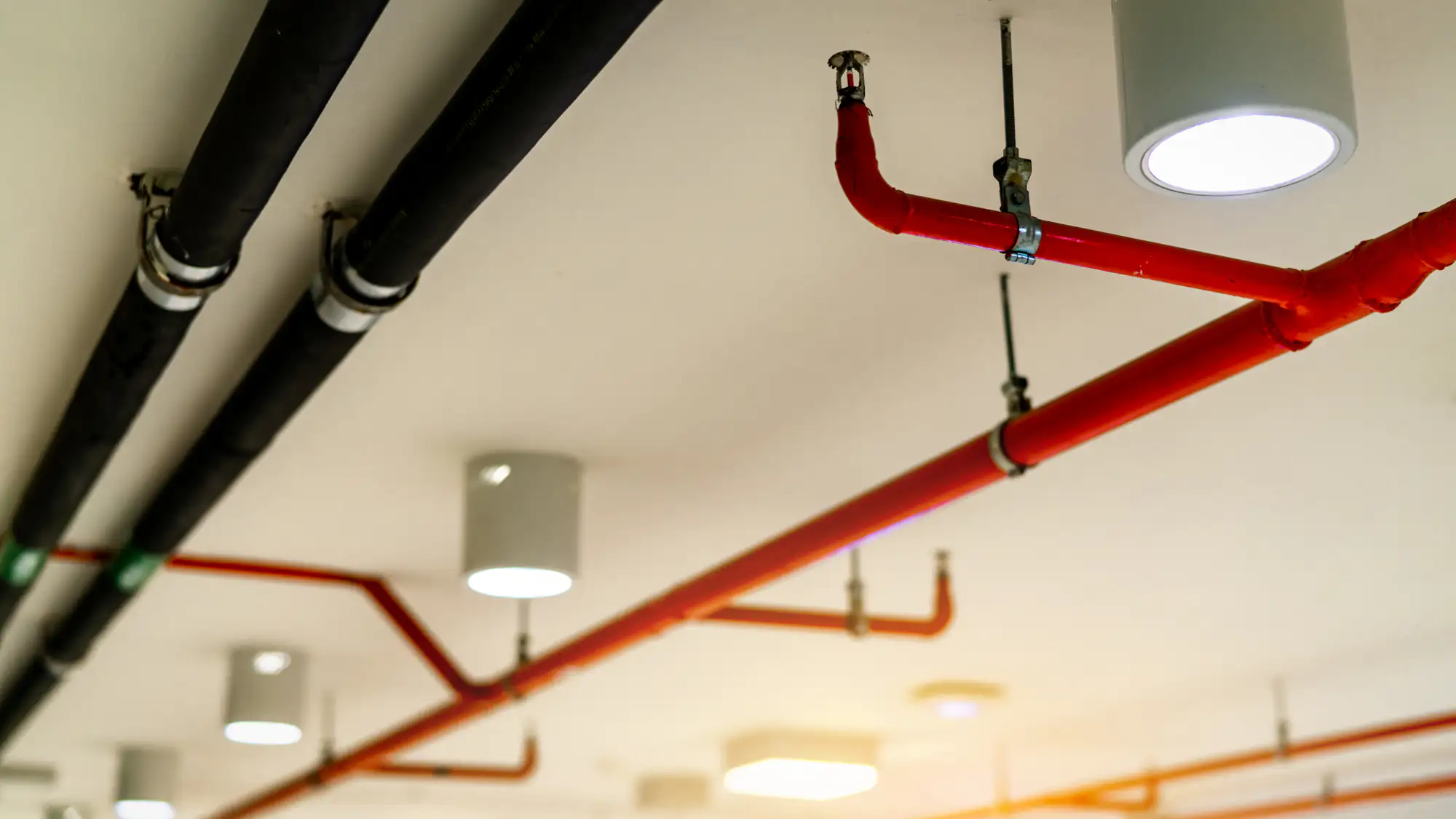
One item that catches Nassau County building owners off guard: Nassau County’s mercantile regulations require quarterly fire sprinkler servicing by a Nassau County-licensed contractor. That’s not annual. Not semi-annual. Quarterly. A lot of facilities are running behind on this without knowing it, and a single missed cycle creates a documentation gap that regulators treat as evidence of non-maintenance.
Smoke Alarm Maintenance: The 10-Year Rule Most Buildings Are Getting Wrong
There’s a widespread assumption that smoke detectors only need to be replaced when they stop working. That’s not what NFPA 72 says. The standard requires smoke detectors to be replaced at 10 years from the manufacture date — not the installation date. The date that matters is printed on the back of the detector itself. In a building where detectors were installed in phases, or where the previous owner installed them, you may have units that are past their replacement window without anyone realizing it.
This is one of the most commonly failed items in commercial inspections, and it’s also one of the easiest to miss because the detector may appear to be functioning normally. Pressing the test button doesn’t tell you whether the sensing chamber is still within calibration. NFPA 72 requires functional smoke testing with listed aerosols to verify actual detector operability — pressing the test button is not a compliant test, even though it’s what a lot of people do.
For Nassau County commercial buildings, this matters in a very practical way. If your building has a mix of detector ages, you may need a partial or full replacement before your next inspection cycle. That takes time to schedule, especially if your fire alarm system requires programming updates when new devices are added. Getting ahead of this in late summer or early fall gives you room to handle it without scrambling.
The other piece of smoke alarm maintenance that tends to get overlooked in commercial settings is the coordination between detector testing and the fire alarm control panel. Devices need to be tested in a way that confirms they’re communicating correctly with the panel — not just that they activate locally. In addressable systems, each device has an address that needs to be verified. This is part of why NICET-certified technicians matter: the testing process requires more than checking whether a light comes on.
Fire Alarm Testing Requirements for Commercial Buildings in Nassau County, NY
NFPA 72 mandates semi-annual fire alarm panel inspections and annual functional testing of every detection device and notification appliance in the building. That means every smoke detector, heat detector, pull station, horn, strobe, and speaker gets tested — not spot-checked, not sampled. All of them. For a mid-size commercial building in Nassau County, that’s a significant undertaking that needs to be scheduled well in advance.
The semi-annual panel inspection is separate from the annual device testing. Both are required. If your records only show one inspection per year, you’re missing a required service cycle, and that gap will show up if the Fire Marshal pulls your documentation.
How to Prepare for a Fire Marshal Inspection in Nassau County, NY
The best way to prepare for a Fire Marshal inspection is to have already done the work. That sounds obvious, but a lot of facilities treat the inspection as the starting point rather than the finish line. By the time an inspector is standing in your building, every system should already be tested, documented, and in working order.
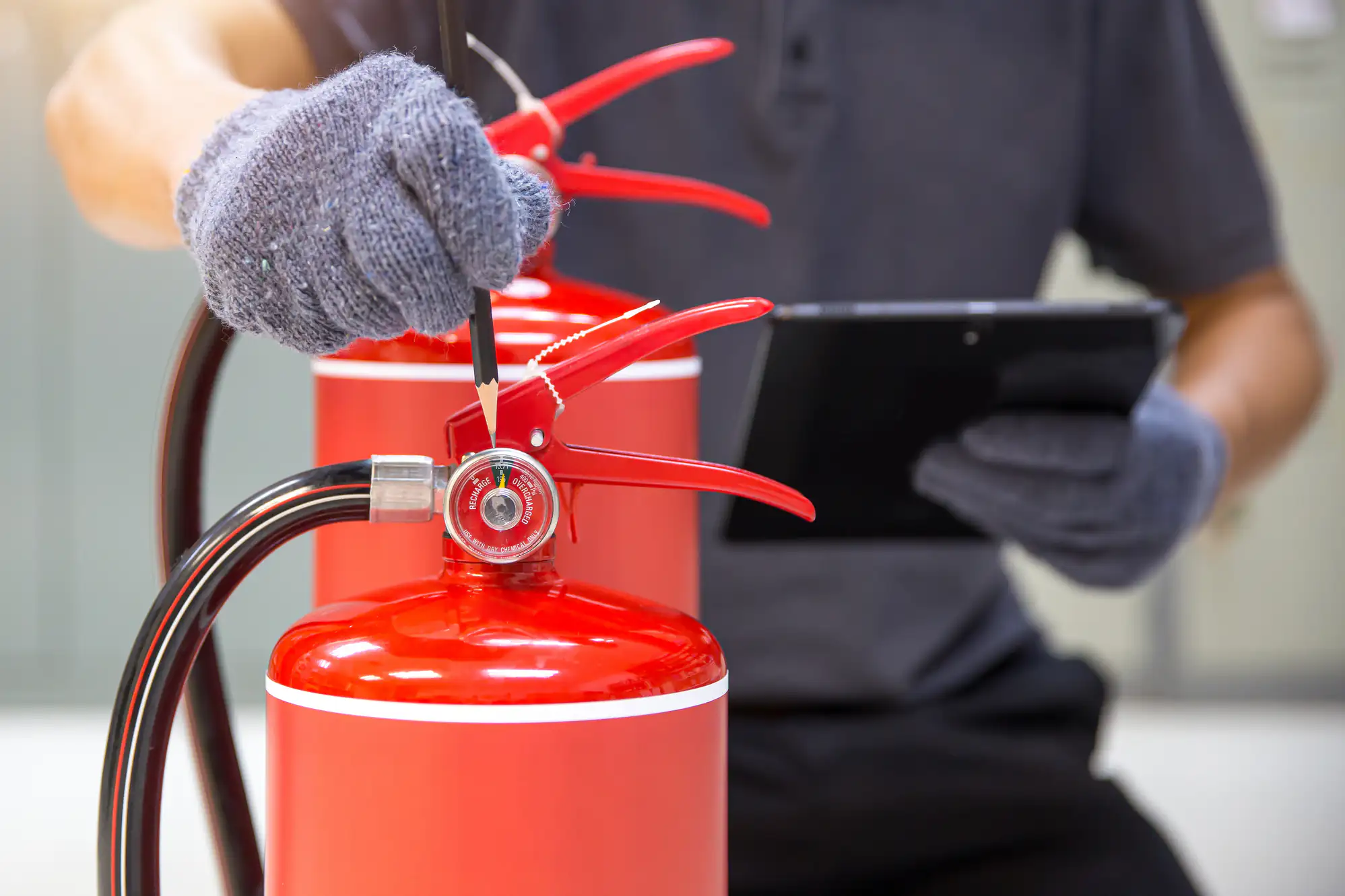
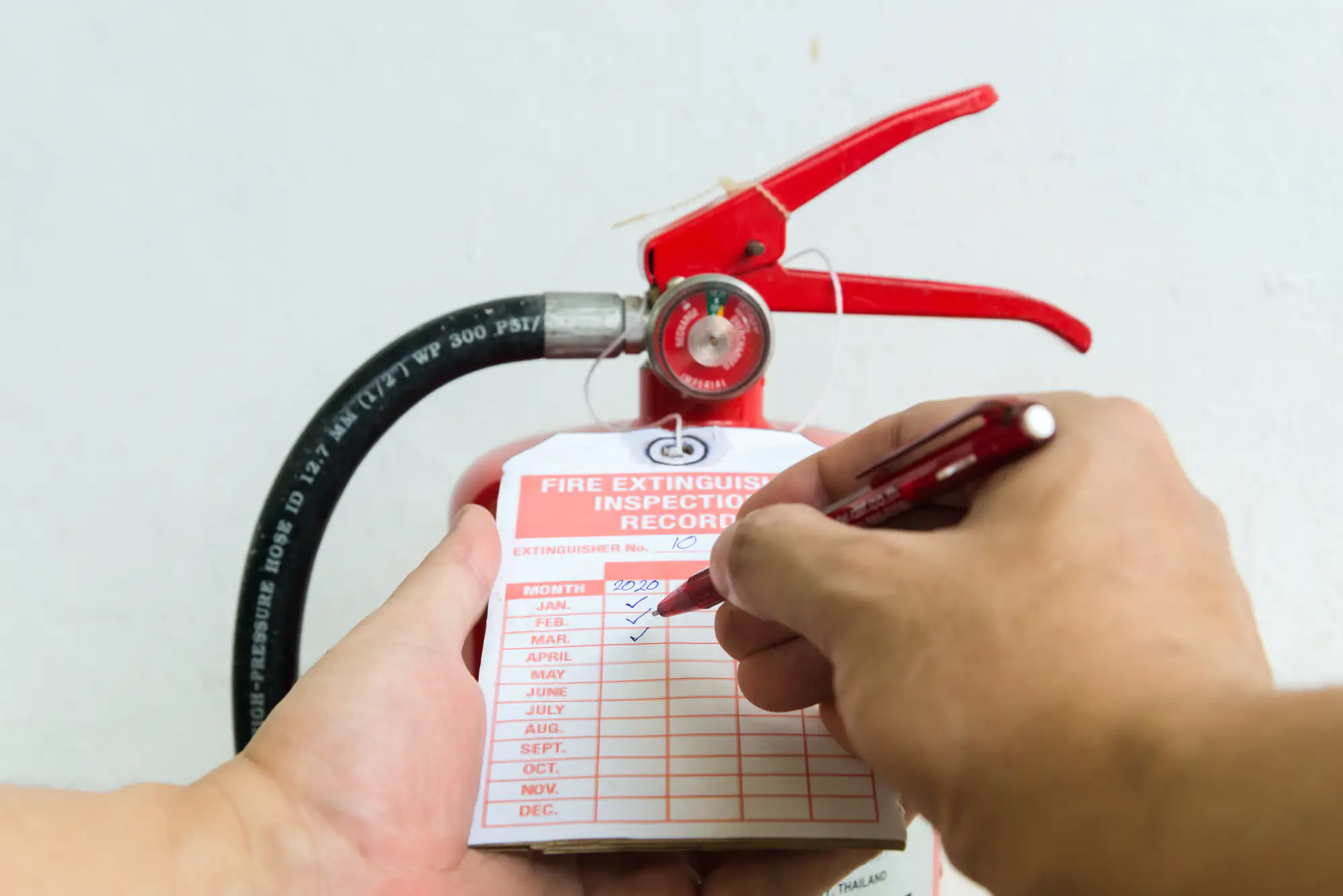
Practically, that means pulling your most recent inspection reports and confirming that every required service interval has been met. For fire alarm systems, you’re looking for semi-annual panel inspections and annual device testing. For sprinklers, you need quarterly servicing records plus the annual main drain flow test. For extinguishers, monthly visual checks and an annual licensed inspection. For emergency lighting, a monthly 30-second test and an annual 90-minute battery discharge test. For fire-rated doors, an annual functional inspection that confirms self-closing, positive-latching, and coordinator operation — not just a visual check.
If you have a BDA or Emergency Responder Communication Enhancement System (ERCES) in your building, that system also needs to be on your compliance radar. These in-building radio amplification systems are classified as life safety systems and must be monitored by the building fire alarm system per IBC and NFPA requirements. It’s an item that doesn’t appear on most generic checklists, and it’s one that catches Nassau County building owners off guard when they receive a violation notice for it.
One practical note on scheduling: fire protection service companies in Nassau County fill up fast as Q4 approaches. If you’re trying to get annual inspections, sprinkler servicing, and any needed repairs done before December 31, you should be scheduling now — not in October. Sixty days of lead time is a reasonable minimum. Less than that, and you’re competing with every other facility manager who waited too long.
Why Managing Multiple Fire Safety Vendors Creates Compliance Gaps
This is something that doesn’t come up in most fire safety checklists, but it’s one of the most common sources of compliance problems we see in Nassau County commercial buildings. A facility manager is juggling one company for fire alarms, a different company for sprinkler inspections, a third for extinguisher service, and sometimes a fourth for suppression systems. Each vendor has its own scheduling window, its own documentation format, and its own compliance calendar. None of them are talking to each other.
The problem isn’t that any one vendor is doing bad work. The problem is that no single party owns the complete compliance picture. When the Fire Marshal asks for a full set of inspection records, you’re assembling documents from three different companies in three different formats, hoping nothing fell through the cracks. And something usually has — a missed quarterly sprinkler service, a detector that one vendor noted as marginal but didn’t replace because it wasn’t their scope, a panel issue that the alarm company flagged but the suppression company never saw.
Working with a single provider that covers the full scope eliminates that coordination problem. When one company handles fire alarms, sprinkler systems, suppression systems, fire extinguishers, and BDA systems, the inspection records are consistent, the scheduling is coordinated, and there’s one point of contact when something needs to be corrected before re-inspection.
For Nassau County facilities, there’s another layer to this: permit submissions. When a system upgrade or violation correction requires a permit, the process involves knowing which forms to file, which marshal to contact, and how to get the system approved without unnecessary delays. A provider with in-house engineering and fire alarm drawing capabilities can handle permit-ready submissions without outsourcing that work — which matters when you’re working against a compliance deadline.
We hold Nassau County licenses 2019AEL75352 and PEL000000259, and our technicians are NICET certified. We’re also an approved contractor by the Nassau County Fire Marshal. When we produce inspection documentation, it’s documentation that holds up.
When Should Nassau County Businesses Schedule Their Fire Safety Inspection?
The honest answer is: earlier than you think. If your annual inspections, quarterly sprinkler servicing, and any needed repairs aren’t already scheduled, the window to get everything done before year-end is narrowing. Nassau County’s compliance requirements don’t pause for a full calendar, and neither does the Fire Marshal’s office.
Use this checklist as a triage tool. Go through each system — alarms, sprinklers, suppression, extinguishers, emergency lighting, fire doors, BDA — and ask yourself when it was last serviced and whether you have the documentation to prove it. If the answer to either question is unclear, that’s where you start.
Island Fire & Defense Systems serves Nassau County commercial facilities across the full scope of fire protection — inspections, testing, maintenance, repairs, and permit submissions, all handled in-house. If you want to get on the schedule before Q4 fills up, reach out for a free estimate and we’ll start from wherever you are.