Summary:
Here’s something most Nassau County business owners don’t know: a fire extinguisher with a gauge in the green zone can still fail completely when you need it most. A broken tamper seal — even one that’s barely visible — can indicate a partial discharge too small to move the needle. The gauge looks fine. The unit isn’t.
That’s the problem with treating annual fire extinguisher inspection as a formality. The real inspection is a mechanical examination, not a visual glance. And if the person who showed up last year spent ten minutes tagging every unit and left without opening a single one, you may be less covered than you think.
Fire Extinguisher Inspection Requirements Under Nassau County and New York State Law
New York State has adopted NFPA 10 — the Standard for Portable Fire Extinguishers — as the governing code for extinguisher compliance. That means the fire extinguisher inspection requirements that apply to your Nassau County business aren’t suggestions. They’re law, and they’re enforced by the Nassau County Fire Marshal’s Office and FDNY.
The requirement covers virtually every commercial property type: restaurants, retail shops, office buildings, warehouses, schools, medical facilities, auto shops, multi-family residential buildings, and houses of worship. If you have employees, customers, or tenants, your extinguishers need to be tagged, documented, and current.
What most people don’t realize is that “inspected annually” is only part of the picture. The full compliance schedule has multiple layers, and missing any one of them creates a gap — even if your annual tags are up to date.
What Does a Yearly Fire Extinguisher Inspection Actually Include?
There’s a meaningful difference between what your staff can do during a monthly walkthrough and what a certified technician must do during the annual maintenance visit. Understanding that distinction matters — both for compliance and for your own peace of mind.
Monthly visual checks are something your team can handle. They’re designed to catch obvious problems: is the unit in its designated place and accessible? Is the pressure gauge reading in the proper range? Is the tamper seal intact and the pull pin in place? Is there any visible corrosion, physical damage, or obstruction? Are the operating instructions legible? These checks take a few minutes and don’t require any special credentials. But they’re not a substitute for annual maintenance — they’re a supplement to it.
The yearly fire extinguisher inspection is a different category of service entirely. NFPA 10 requires that annual maintenance include a thorough examination of the mechanical parts, the extinguishing agent, and the expelling means of each unit. That work must be performed by a trained, certified technician using the manufacturer’s service manual and proper tools. It’s not a visual check. It’s a hands-on mechanical examination.
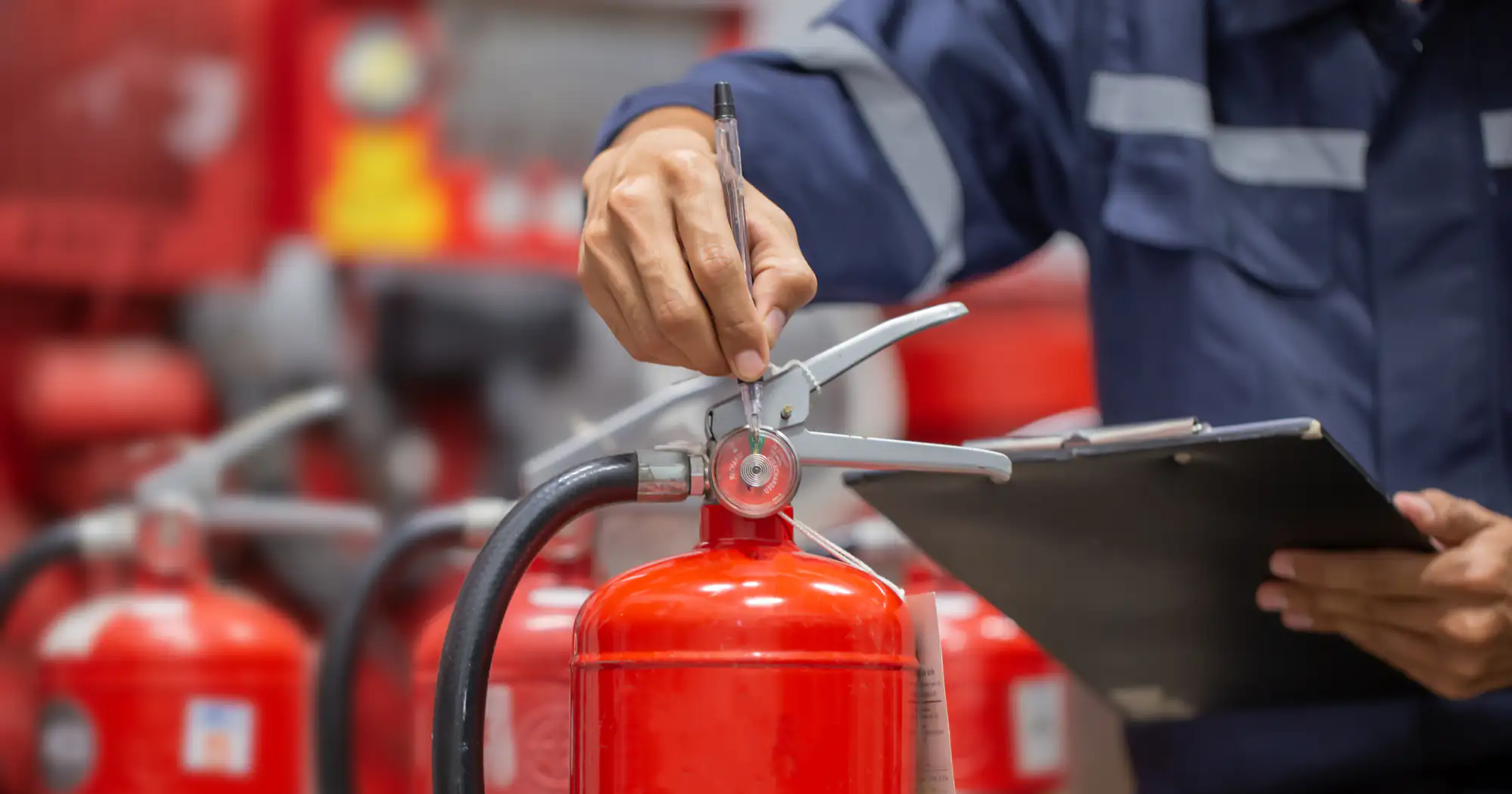
During a proper annual inspection, the technician will examine the exterior for damage, corrosion, or worn components; verify the pressure gauge is accurate and the agent hasn’t settled or degraded; check the tamper indicator and pull pin carefully — not just glance at them; confirm the discharge nozzle and hose are clear and undamaged; and document everything in a detailed inspection report noting any deficiencies and required corrective actions. The unit then receives a serialized service tag that serves as your proof of compliance for fire marshal inspections, insurance audits, and Certificate of Occupancy reviews.
That last point matters more than people expect. In Nassau County, most commercial insurance policies require documented annual inspection as a condition of coverage. The tag attached by a licensed contractor — not just any tag — is what satisfies that requirement.
Fire Extinguisher 6-Year Maintenance: The Compliance Milestone Most Nassau County Businesses Have Never Heard Of
If your extinguishers are stored-pressure dry chemical units — which is the most common type in Nassau County commercial buildings — there’s a compliance milestone beyond the annual inspection that almost no one talks about. NFPA 10 requires an internal examination of these units at six-year intervals. Not every twelve years. Not “eventually.” Every six years from the date of manufacture or the last internal exam.
This internal examination goes well beyond what the annual inspection covers. The technician fully discharges and disassembles the unit, inspects the internal components for corrosion or damage, examines the extinguishing agent for contamination or caking, replaces any worn parts, and reassembles and recharges the unit before returning it to service. It’s a substantially more involved process — and it’s a hard legal requirement under NFPA 10.
Here’s why this matters in practice: if your extinguishers are five or six years old and you’ve been getting annual inspections every year, you may still be out of compliance if no one has ever performed the internal examination. Many Nassau County business owners discover this during a fire marshal inspection or insurance audit — not before. By then, the violation is already on record.
Beyond the six-year internal exam, NFPA 10 also requires hydrostatic testing at specific intervals depending on the extinguisher type. Stored-pressure dry chemical units require hydrostatic testing every twelve years; CO2 extinguishers require it every five years. Hydrostatic testing uses high-pressure water to check the cylinder for leaks, weak spots, or structural compromise that wouldn’t be visible from the outside. It’s the kind of test that catches problems before they become failures — and it’s required regardless of how well the unit has been maintained.
The practical takeaway: if you don’t know when your extinguishers were manufactured or when they last had an internal exam, that’s the first question to ask the next time a technician comes out. Annual tags are necessary. They’re not sufficient on their own.
Fire Extinguisher Maintenance Schedule: The Full Four-Tier Picture
Most competing content in this space stops at “get it inspected annually.” That’s accurate as far as it goes, but it leaves out three-quarters of what NFPA 10 actually requires. The complete fire extinguisher maintenance schedule has four distinct tiers, and each one has a different purpose, a different frequency, and different rules about who can perform it.
Think of it as a layered system. Monthly visual checks are the baseline — fast, staff-performed, and designed to catch obvious problems between professional visits. Annual maintenance is the core professional service — a certified technician, a mechanical examination, proper documentation. The six-year internal examination is a deeper service milestone for stored-pressure units. And hydrostatic testing is the structural integrity check that happens every five or twelve years depending on extinguisher type.
Missing any tier creates a compliance gap. The Nassau County Fire Marshal’s Office doesn’t distinguish between “I didn’t know about the six-year requirement” and “I skipped it intentionally.” The outcome is the same.
Who Can Legally Perform a Fire Extinguisher Inspection in Nassau County?
This is where Nassau County has requirements that go beyond what many business owners expect — and where the difference between a legitimate inspection and a fraudulent one becomes very real.
Nassau County Mercantile Regulations require that any contractor performing fire extinguisher inspection, testing, and maintenance hold a valid Type 2 License from the Nassau County Fire Marshal’s Office. The technician performing the work must also hold a Certificate of Fitness for the same scope of service. These aren’t optional credentials. They’re the baseline for any inspection to be considered valid under Nassau County fire code.
Why does this matter? Because fire extinguisher inspection scams are a documented problem. Fraudulent operators have targeted businesses across the region, collecting cash for inspections that were never actually performed and attaching tags that aren’t recognized by any licensing authority. The business owner gets a tag on the wall. The fire marshal shows up and finds the documentation doesn’t hold up. The violation goes on the business owner’s record, not the contractor’s.
The simplest protection is to verify credentials before scheduling. Ask for the contractor’s Nassau County license number and confirm it with the Fire Marshal’s Office. We hold Nassau County licenses 2019AEL75352 and PEL000000259 — both publicly verifiable. We’re also approved by the Nassau County Fire Marshal and FDNY, and our technicians are NICET certified, which is the nationally recognized credential for fire protection professionals. That combination of local approval and national certification is what separates a real inspection from one that only looks like one.
What Should You Receive After a Proper Annual Fire Extinguisher Inspection?
A lot of Nassau County businesses have had the experience of a technician showing up, walking the building quickly, attaching tags to each unit, and leaving — all within twenty or thirty minutes. For a building with a handful of extinguishers, that timeline might be legitimate. But it’s worth knowing what you should actually walk away with after a real inspection, because the documentation is as important as the service itself.
After a proper annual inspection, you should receive a serialized service tag securely attached to each extinguisher. In the Nassau County and FDNY jurisdiction, this means a serialized tag issued by a licensed contractor — not a generic label. The tag should show the date of inspection, the technician’s name or ID, and when the next inspection is due. This is the physical proof that satisfies a fire marshal, an insurance auditor, and a Certificate of Occupancy review.
Beyond the tag, you should receive a written inspection report documenting what was examined on each unit, any deficiencies found, and what corrective actions are required. If a unit failed inspection — low pressure, damaged components, a compromised agent — that needs to be in writing, along with a clear explanation of what happens next. Does it need recharging? Replacement? A six-year internal exam that was overdue? A legitimate inspection company will tell you clearly and document it, not quietly tag the unit and hope you don’t notice.
We provide a detailed inspection report after every visit — not as an upsell, but because that’s what the standard requires and what your records need. We’re also an authorized Amerex and Badger extinguisher dealer, which means if a unit needs to be replaced or recharged, we can handle it using manufacturer-approved parts and service manuals. One visit, one provider, everything documented.
Annual Fire Extinguisher Inspection in Nassau County: What to Do Next
If there’s one thing worth taking from this page, it’s that a current tag and a green gauge are not the same thing as genuine compliance. The full NFPA 10 schedule — monthly checks, annual professional maintenance, six-year internal examinations, and hydrostatic testing — exists because fire extinguishers can look fine and still fail. Nassau County enforces these requirements consistently, and the businesses that get caught out are almost always the ones that assumed everything was covered.
The good news is that getting into full compliance isn’t complicated when you’re working with a licensed, credentialed provider who knows what the complete schedule looks like and keeps your documentation in order.
If you’re not sure where your extinguishers stand — whether the annual inspections have been thorough, whether the six-year milestone is approaching, or whether the contractor you’ve been using is properly licensed in Nassau County — we’re a straightforward call to make. Island Fire & Defense Systems handles the full scope of fire extinguisher service for Nassau County businesses, and we’ll give you a clear picture of where you actually stand.